AI Answering
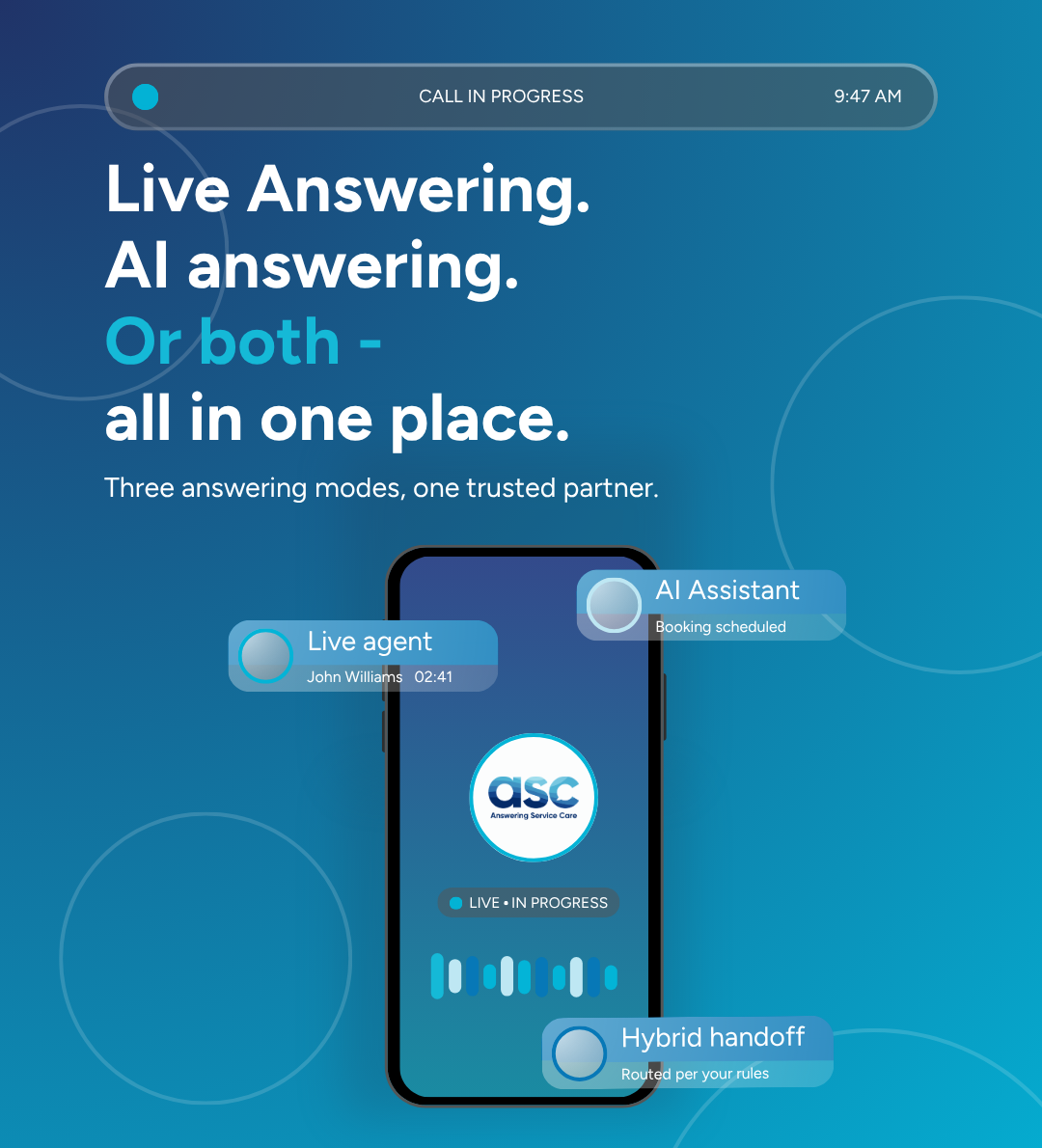
How ASC AI answering works: a multilingual AI assistant that answers your calls 24/7 and escalates to a live agent whenever a call needs a person.
ASC offers AI answering, live answering, and hybrid models. AI answering gives your business 24/7 call coverage with a virtual assistant that answers in your name, follows your call handling rules, captures the right details, and can escalate to a live agent when needed.
ASC AI capabilities also extend beyond voice calls. Depending on your setup, ASC can support Voice AI, SMS AI, text-to-speech, speech-to-text, and multilingual workflows in 80+ languages.

Try a live AI demo
Test live AI answering flows across several industry use cases. Each number demonstrates how ASC handles intake, routing, escalation, and scheduling in a practical workflow.
Home Services (Anchor Plumbing Co.)
(866) 651-1340
Identifies true plumbing emergencies, routes urgent calls, and books routine jobs on a live calendar.
IT & Tech Support (Cortex IT / Northpoint)
(844) 791-0976
Handles first-level help desk requests, including password resets, and escalates critical outages.
Property Management (Marlin Bay)
(866) 651-1353
Captures property requests and separates standard maintenance from urgent tenant emergencies.
Finance & Accounting (Saul the Tax Man)
(866) 651-1348
Manages client intake and schedules new or returning tax appointments directly.
Legal Services (Hank Hill Law)
(866) 651-1489
Runs bilingual English and Spanish legal intake, screens for conflicts, and captures case details.
By texting these demo numbers, you agree to receive SMS from Answering Service Care. Message and data rates may apply. Message frequency varies. Reply HELP for help or STOP to opt out.
How AI answering fits into your options
ASC supports three answering models: AI, live, and hybrid. Each one serves a different operational need.
AI answering works well for structured, repeatable interactions. Live answering works well when every caller should speak with a person from the start. Hybrid combines both approaches under one call handling strategy.
What AI answering does
Answers every call, 24/7. The AI assistant covers days, nights, weekends, and holidays.
Uses your greeting and script. It represents your business the way you set it up.
Captures caller details. It collects the information you need and delivers it with your messages.
Routes and transfers calls. It follows your rules for call handling and escalation.
Supports scheduling workflows. Where enabled, it can book appointments during the call.
Handles multilingual conversations. It supports callers in 80+ languages.
Escalates to a live agent. Urgent, sensitive, or complex calls can move to a person in real time.
Core AI capabilities
ASC can support AI-driven workflows across more than one channel and interaction type.
Voice AI. Handles spoken conversations for intake, routing, message capture, and escalation.
SMS AI. Supports text-based workflows for intake, updates, and follow-up.
TTS. Delivers spoken responses using text-to-speech.
STT. Uses speech-to-text to interpret caller responses and drive workflow logic.
Multilingual support. Supports AI interactions in 80+ languages.
ASC also uses Quality Assurance AI in internal quality workflows. It is not positioned as a standalone product.
For a quick side-by-side of AI, live, and hybrid answering, see Choosing the right answering model.
AI answering vs. live answering
ASC offers both models. The right fit depends on the type of conversations you handle, the level of human interaction you want, and how you manage volume.
First response
Immediate automated response
Human-led response from the start
Best fit
Routine, structured call flows
Nuanced, sensitive, or high-touch conversations
Scalability
Handles many calls at once
Staffed based on expected call volume
Workflow style
Follows configured rules and scripts
Uses trained agents with script support
Handoff options
Can transfer based on escalation rules
Can resolve live or escalate internally
Coverage model
Strong fit for 24/7 automation
Strong fit for 24/7 human answering
Where AI answering fits best
AI answering works well when speed, consistency, and structured call handling matter most.
Common fits include:
after-hours call handling
overflow support during busy periods
lead capture and message taking
appointment requests and routine intake
repetitive call types that follow a defined workflow
Industry fit
AI answering is especially useful when callers need a fast response and the workflow can follow clear business rules.
Common industry fits include:
Home services. Route urgent service calls and book standard jobs.
IT support. Capture first-level requests and escalate outages fast.
Property management. Separate routine maintenance from true emergencies.
Finance and accounting. Handle intake and schedule appointments cleanly.
Legal services. Support bilingual intake and structured case screening.
When hybrid is the right fit
Some businesses want automation without losing the option of a live conversation. That is where hybrid works best.
Hybrid is a strong fit when:
some calls are simple, but others need judgment or empathy
callers may need urgent escalation
your team wants automation for routine work and live support for exceptions
you want better coverage without forcing every interaction through the same model
When live answering is the right fit
Some call types are best handled by a trained live agent from the start.
Live answering is often the better fit when:
callers expect empathy, reassurance, or discretion
conversations require judgment or flexible problem solving
intake is highly nuanced or brand-sensitive
your business treats every caller interaction as a high-touch experience
What this means operationally
AI answering helps reduce missed calls, shorten response times, and create more consistent handling for routine interactions. Live answering supports businesses that want every caller greeted by a person. Hybrid helps teams balance both models under one operating approach.
For answering services and growing businesses, this makes it easier to align call handling with service expectations, staffing strategy, and client needs.
Explore AI answering
Last updated
Was this helpful?

