
Los Angeles, CA Answering Service


Serving Los Angeles, CA, and the broader Los Angeles County region, our answering service supports local businesses with live call handling that works alongside the number their customers already recognize.
Los Angeles supports a large, high-activity economy built around healthcare, entertainment, trade and logistics, hospitality, financial services, business services, and other service-driven industries. LA County’s 2024 GDP exceeded $886 billion, and that scale helps explain why so many businesses across the region depend on consistent communication to manage scheduling, intake, lead response, vendor coordination, and ongoing customer support.
Across Los Angeles, daytime calls often come from patients, tenants, clients, customers, vendors, and new leads who want quick answers and clear next steps. After hours, call patterns often shift toward urgent property issues, dispatch requests, scheduling needs, and messages that still need to be documented while internal staff are unavailable. In both cases, callers expect to reach a person who can respond clearly and keep the interaction moving.
Our 24/7 Los Angeles, CA answering service provides live receptionist coverage for overflow, after-hours, or full-time call handling, so businesses can maintain a more consistent response without relying on a single desk or employee to manage every call. Operators answer in your business name, follow your script, capture structured intake details, transfer urgent calls when appropriate, and deliver secure messages to your team.
Why Los Angeles Area Codes Still Shape First Impressions
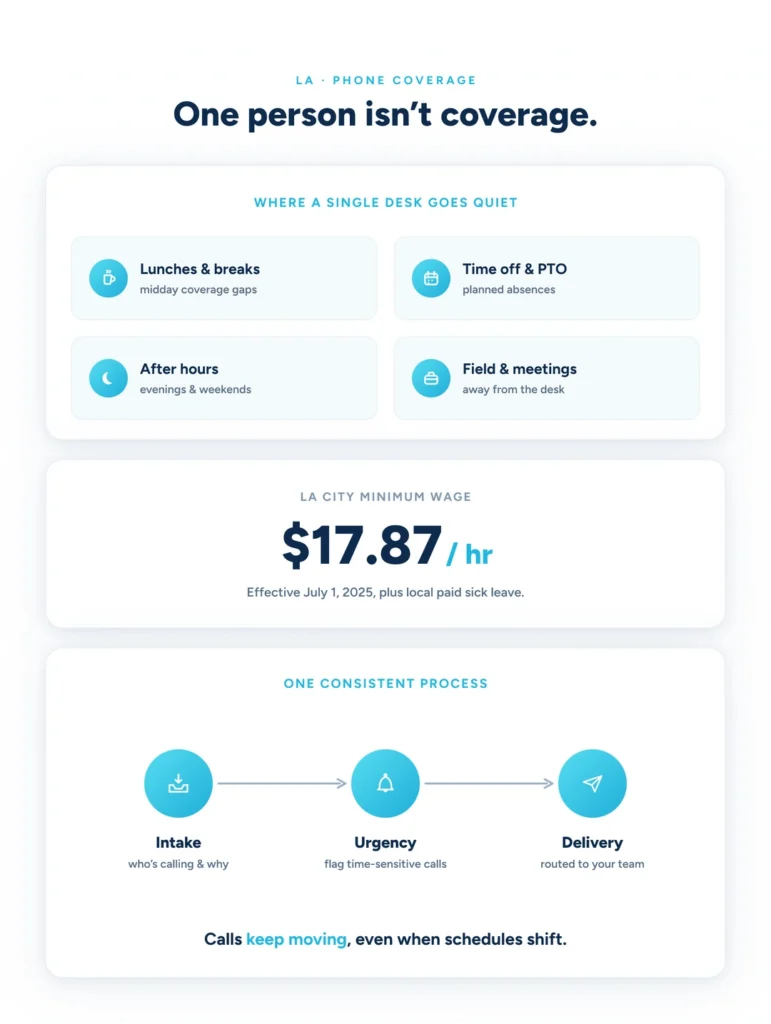
Local phone numbers still carry meaning across Los Angeles. The California Public Utilities Commission lists 213, 323, and 738 in central Los Angeles, 310 and 424 on the Westside, 818 and 747 in the Valley, and 626 in nearby eastern areas tied to the broader LA region. Those number groupings are familiar to callers and remain part of how businesses signal local presence.
In a city where callers make quick decisions, a familiar Los Angeles number can buy your business a little more trust before the conversation even begins. That recognition can matter when a caller is deciding whether to stay on the line, leave a voicemail, or move on to the next option.
We support businesses across Los Angeles and nearby communities, including Downtown LA, Hollywood, Koreatown, West LA, Century City, Sherman Oaks, Encino, Studio City, Glendale, Pasadena, Torrance, Long Beach, and surrounding parts of Los Angeles County. Coverage can also be organized around the neighborhoods and service areas your team already serves, which helps the phone experience feel more connected to the market you work in every day.
What High Los Angeles Office Costs Mean for Front Desk Coverage
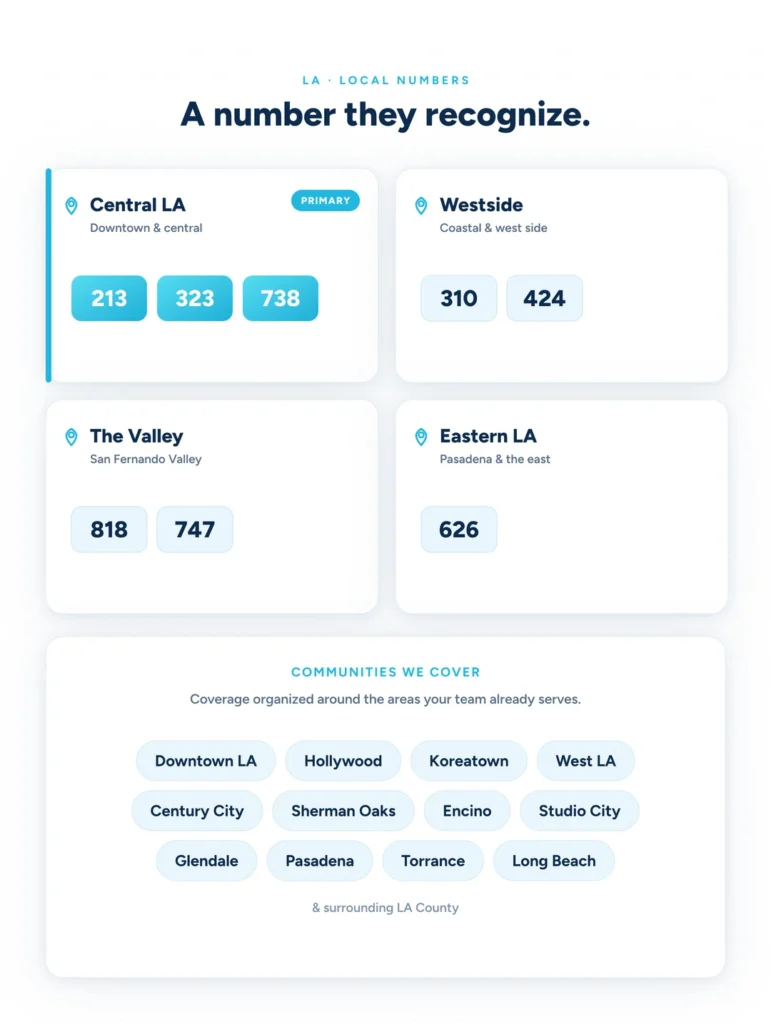
Office costs in Los Angeles continue to shape staffing decisions, especially for businesses deciding how much space and payroll to devote to front desk functions. In Q1 2025, Cushman & Wakefield reported average Los Angeles office asking rents at roughly $3.52 per square foot per month.
A 1,500-square-foot office leased at that rate comes to about $5,280 per month, or roughly $63,360 per year before utilities, insurance, maintenance, furniture, and other occupancy costs. In a high-cost market, dedicating part of that footprint to reception coverage can quickly become expensive, particularly when a large share of customer interactions occurs over the phone rather than in person.
For many Los Angeles businesses, the most important front-door interaction no longer happens in the lobby. It happens on the phone, often while staff are already busy with patients, clients, tenants, field work, or internal operations. A Los Angeles answering service separates call coverage from physical office space, allowing businesses to maintain a live answer without expanding square footage or stretching an in-house team.
Why Keeping Phones Covered in Los Angeles Takes More Than One Employee
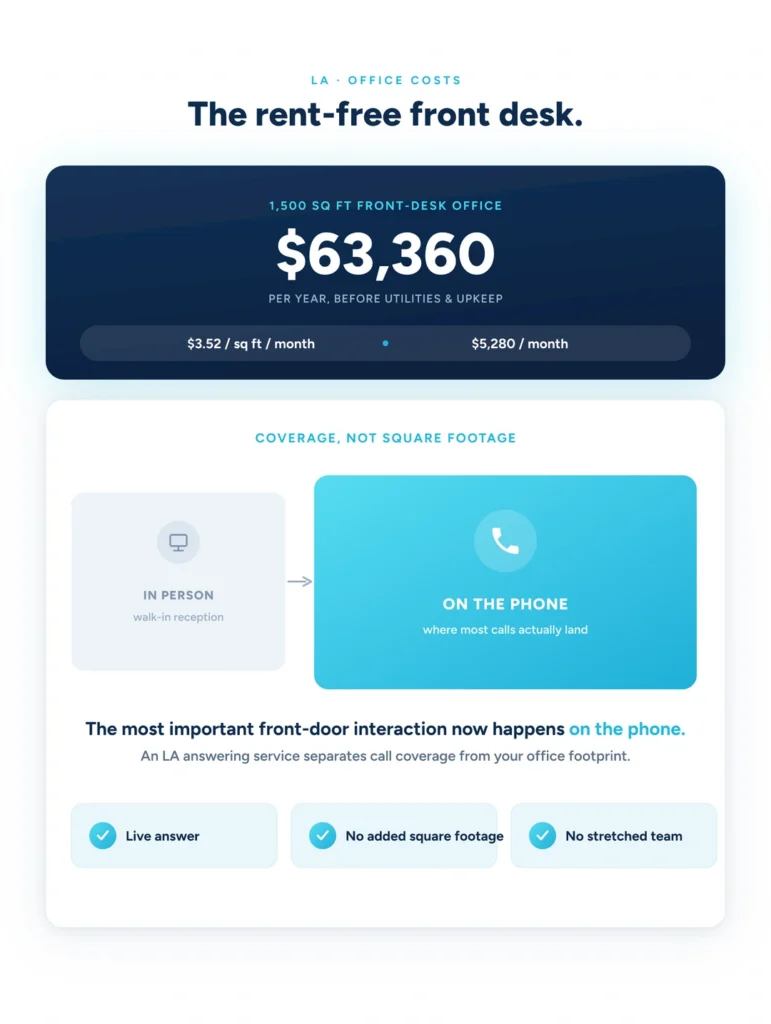
Maintaining phone coverage in Los Angeles usually requires more planning than assigning calls to a single receptionist. Businesses still need someone available during lunches, breaks, time off, and evenings, and that becomes harder when employees are split between appointments, meetings, field work, and other responsibilities away from the desk.
Employment costs also affect how that coverage is built. The City of Los Angeles’ minimum wage reached $17.87 per hour on July 1, 2025, and employers must also factor in local paid sick leave requirements. Together, those obligations raise the cost of maintaining dependable in-house phone support.
Los Angeles adds another layer because many businesses do not operate on a single, fixed routine. Teams may be spread across offices, job sites, or service areas throughout the day, making it harder to maintain consistent call handling without backup.
As a result, phone coverage often depends on more than one person and multiple schedules. Businesses may need overlap, cross-training, or secondary coverage to prevent missed calls when demand picks up or staffing shifts.
That is part of why answering services continue to make sense in Los Angeles. Rather than rebuilding phone coverage every time schedules change, businesses can set clear instructions for intake, urgency, and message delivery, then keep calls moving through a consistent process.
The Cost of Reception Staffing in Los Angeles
Reception payroll in Los Angeles can look manageable at first glance, but the full cost is higher once wages, taxes, leave, and overlap coverage are factored in. The Bureau of Labor Statistics reported that receptionists and information clerks in the Los Angeles-Long Beach-Anaheim metro area averaged $21.03 per hour in its latest regional wage release.
At $21.03 per hour, a full-time receptionist working 40 hours per week earns roughly $43,742 per year in base wages. That figure does not include payroll taxes, unemployment insurance, paid leave, training time, turnover, or the cost of backup coverage when that employee is unavailable. Once those factors are added, the cost of maintaining reliable in-house phone coverage increases further.
Coverage also does not stay static. Lunches, absences, seasonal spikes, and longer service windows can turn what looks like one role into a multi-person system. That is one reason many Los Angeles businesses compare in-house reception staffing with virtual receptionist coverage rather than assuming the front desk is the default lower-cost option.

Answering Service Care plans start at $40 per month, depending on plan type and call volume. We recommend a tier based on your hours, average call length, and whether you need transfers, scheduling, or bilingual support.
What Drives Call Volume Across Los Angeles Businesses
The Los Angeles economy creates a very specific kind of call environment. LAEDC identifies major county strengths in healthcare, entertainment, trade and logistics, hospitality and tourism, finance, fashion, and business services. Those sectors generate a constant mix of appointment requests, vendor communication, client intake, service updates, and operational coordination.
The industries change, but the caller’s expectation does not. People want an answer, direction, and to know what happens next. A patient wants to know whether an issue should be routed urgently. A production contact wants to know who can receive time-sensitive information. A logistics partner wants confirmation that an update reached the right team. A prospective client wants to feel like the business is paying attention.
Live answering keeps those interactions organized from the start. Rather than letting the phone create bottlenecks inside a busy office, businesses can route calls through a defined intake process that captures the right details and keeps communication moving.

Healthcare and professional services play an outsized role in Los Angeles, and both depend on organized intake. The region includes major healthcare institutions such as Cedars-Sinai, UCLA Health, and Kaiser Permanente, while firms like CBRE, AECOM, and City National Bank reflect the scale of client-facing professional work across the county. These kinds of organizations operate through appointments, referrals, consultations, service coordination, and ongoing communication, which often need to be documented and routed correctly the first time.
A medical office may need to record appointment requests, referral questions, billing calls, and after-hours concerns without overwhelming internal staff. A legal, financial, or consulting office may need to capture new inquiries, route messages to the appropriate department, and preserve context between the initial call and the next step. In both settings, callers usually want clarity right away.
For teams spread across a large metro, live answering creates a cleaner point of entry. Calls can be documented consistently, prioritized by urgency, and sent to the correct person without forcing staff to interrupt active work every time the phone rings.
For healthcare and professional offices, Answering Service Care offers:
- patient appointment scheduling and rescheduling requests
- referral coordination between providers or departments
- new client and consultation intake
- after-hours message capture for urgent concerns
- administrative call routing across offices or teams
Los Angeles has a communication rhythm shaped by entertainment in a way few cities do. The Motion Picture Association’s members include Disney, Netflix, Sony, Universal, Paramount, Prime Video and Amazon MGM Studios, and Warner Bros. Discovery, all of which underscore how central film, television, streaming, and media operations remain to the region.
In this space, the phone often carries details that cannot wait long. A production office may need schedule changes documented. A media firm may need account-related calls routed correctly. A creative business may need after-hours lead capture while the team is in meetings, on set, or focused on delivery deadlines. The call itself may be brief, but what matters is recording it accurately and getting it to the right person without delay.
Live answering gives entertainment and media businesses a way to stay reachable without slowing the workday. Messages can be screened, structured, and delivered according to your workflow so internal teams can stay focused on production, client management, and deadlines.
For entertainment and media operations, Answering Service Care offers:
- production office message intake
- vendor and scheduling updates
- after-hours lead capture
- department-based routing for active accounts
- overflow support during campaigns, shoots, and peak periods
Los Angeles also depends heavily on logistics, transportation, shipping, and field-based work. The Port of Los Angeles reported that it handled about 6.7 million loaded TEUs in 2025, accounting for 17% of all U.S. containerized waterborne international trade that year, underscoring the scale of coordination tied to cargo movement in the region. Companies and workforces across shipping, warehousing, engineering, utilities, and field operations depend on fast message flow between teams, vendors, and customers.
That scale creates a communication environment where calls often involve job-site coordination, service requests, routing changes, shipment updates, vendor contact, and time-sensitive operational details. In those settings, the phone is tied directly to movement. If a message is missed or poorly documented, the delay can carry into scheduling, dispatch, and response times.
Live answering helps manage that flow without interrupting people who are already working in the field or coordinating active operations. Calls can be logged clearly, sorted by urgency, and routed according to the rules your team already uses.
For ports, warehouses, crews, and field operations, Answering Service Care offers:
- vendor and supplier coordination updates
- dispatch-style message intake for field teams
- equipment service calls and maintenance scheduling
- delivery and shipment update handling
- internal coordination between operations, support, and management
Los Angeles businesses often need calls answered quickly, documented clearly, and passed to the right person without delay. Medical offices handle patient questions and appointment changes; property managers respond to tenant concerns; legal and professional offices manage new inquiries; and service businesses field requests that often require same-day attention. Many of these operations involve multiple departments, mobile staff, or extended hours, which makes the way a call is received and passed along just as important as the call itself.
When that process is inconsistent, the issue usually goes beyond a slower response. A message may be incomplete, routed to the wrong person, or require extra follow-up before anyone can act on it. In workplaces that depend on accurate information and timely coordination, such a breakdown can create friction for both the team and the caller. A more structured intake process helps reduce those problems by capturing the right details from the start and sending them to the right people.
Los Angeles virtual receptionists give businesses a more reliable starting point for incoming calls. Each call is answered in your business name, and operators document the information in a format your team can use right away. This is especially useful for businesses managing steady call volume, multiple lines of responsibility, or teams that are not always sitting at one desk.
When calls come in, we: (1) answer in your business name, (2) follow your script, (3) record caller and issue details, (4) identify urgency, (5) transfer or escalate when needed, and (6) send the message by SMS, email, or portal.
Call handling can also be aligned with how your business already operates. Urgent matters can go straight to the correct contact, while routine calls can be logged and delivered for follow-up. Workflows can be organized by department, call type, schedule, or other priorities, giving your team more control over how communication moves through the business.
Support may also include bilingual answering, appointment intake, unwanted call filtering, and secure message delivery when needed. That structure helps keep communication clear and organized while making sure callers reach a live person who can move the conversation forward.
Answering Service Tools Built for Los Angeles Workflows
The service can be mapped to the pace and structure of your business, whether calls need to be sorted by urgency, department, neighborhood, or time of day. Los Angeles businesses rarely all need the same phone workflow, so call handling should match the way the organization already operates.
Answering Service Care can tailor Los Angeles call coverage to your business’s needs. Support can include live answering during business hours, overflow coverage during peak periods, and after-hours answering for evenings, weekends, and holidays.
Our answering service offers:
- live answering built around your hours
- branded greetings and tailored intake flow
- immediate transfers for urgent situations
- call routing based on urgency, team, or function
- message delivery by text or email
- secure online access to call records
- bilingual support for incoming callers
- screening for spam and unwanted calls
Additional features may include appointment intake and privacy-conscious message handling for healthcare, legal, and financial communication. This helps keep communication organized without adding internal complexity.
How a Los Angeles Answering Service Fits Into Daily Operations
A Los Angeles answering service provides businesses with a reliable way to manage inbound calls without expanding internal staff or diverting employees from their core work. Coverage can be adjusted based on timing, volume, and call priority, making it easier to support both routine communication and urgent situations. Support may include:
- live answering during regular hours, heavy call periods, and evenings or weekends
- business-name greetings and intake steps shaped around your internal process
- direct transfers for urgent matters with clear escalation rules in place
- scheduling support and structured intake for prospective callers
- bilingual answering for businesses serving a wider caller base
- screening that cuts down on spam and robocall interruptions
- message delivery by text, email, or secure online access
- thoughtful handling of confidential details in healthcare, legal, and financial settings
Each call is answered by a live operator, documented clearly, and delivered according to your instructions so your team can stay focused on client work, service delivery, and daily operations.

Frequently Asked Questions:
We do. We provide 24/7 live answering for Los Angeles businesses that need help after hours, on weekends, during holidays, or when daytime call volume spikes. Instead of pushing callers to voicemail, a live receptionist answers the call, follows your instructions, and helps move the conversation in the right direction.
Yes. Our Los Angeles virtual receptionists answer in your business name and work from your custom greeting, script, and intake requirements. We can record the details that matter to your team, including caller information, reason for calling, urgency, and scheduling-related notes, then send the message in a consistent format.
They can. We can follow separate escalation paths based on the type of business you run and the kind of call coming in. Whether the issue involves an urgent tenant problem, a patient concern, or a dispatch request, we can transfer or escalate based on the rules you set for timing, severity, and contact order.
Of course. Message delivery can be set up to align with how your business operates. We can send messages by text, email, or secure portal and route them by department, call category, time of day, or service area, which is especially useful for businesses covering different parts of Los Angeles County.
Yes. We support businesses that need a more careful approach to sensitive information. Call handling can be structured around approved scripts, limited-detail intake, and controlled message delivery. If your organization needs HIPAA-specific setup, including a BAA, those requirements should be addressed during onboarding.
Supporting Businesses Across Los Angeles and the Surrounding Region
Different parts of Los Angeles create different kinds of incoming calls. A practice in Beverly Grove may need patient questions documented after hours. A contractor in the Valley may need urgent dispatch messages routed straight to a field lead. A property manager near Koreatown may rely on weekend maintenance intake. A law office Downtown may want new client inquiries documented and prioritized by urgency. A Westside business may need overflow support during daytime spikes.
Answering Service Care works with businesses throughout Los Angeles, including Downtown LA, Hollywood, Koreatown, West LA, Century City, Sherman Oaks, Encino, Studio City, Pasadena, Glendale, Torrance, Long Beach, and nearby communities. Coverage can be structured around how each organization operates, whether that means daytime overflow, full after-hours support, weekend coverage, or a combination of all three.
Call information is captured in a clear, organized format and delivered only to the appropriate contacts through secure channels. This helps businesses maintain control over communication while ensuring that important details reach the right person without delay, especially in environments where accuracy and confidentiality matter.
Keeping Your Los Angeles Business Number While Adding Live Call Coverage
Los Angeles businesses typically rely on carriers such as Verizon, AT&T, T-Mobile, VoIP systems, and hosted phone platforms, all of which offer standard call forwarding options. That means you do not need to change your existing business number to begin service.
Using simple call-forwarding instructions or a step-by-step call-forwarding guide, businesses can decide exactly when and how calls are handled. Calls can be routed to a live answering service during peak hours, after hours, or only when lines are busy, giving you control over coverage without disrupting your current setup.
This approach keeps your number consistent for customers while improving how calls are managed internally. It creates a smoother caller experience and gives your team the flexibility to adjust coverage as demand changes.

- How LA Area Codes Signal Local Presence
- Office Rent and the Case for Phone Coverage
- California Wage Rules for LA Call Staffing
- What Receptionists Really Cost in LA
- Which LA Industries Drive Call Volume
- Answering Features Built for LA Businesses
- Where a Live Answering Service Fits In
- LA Answering Service FAQ
- Why LA Teams Rely on Live Answering
- Setting Up Call Forwarding for LA Numbers