
Long Island Answering Service

Long Island supports one of the most active regional economies in the Northeast, with Nassau and Suffolk counties home to nearly 3 million residents and a business base tied to healthcare, professional services, construction, real estate, and research. The region’s economy is closely linked to New York City, but it also operates as a major service market of its own, with businesses handling steady phone traffic tied to appointments, intake, scheduling, and urgent service needs.
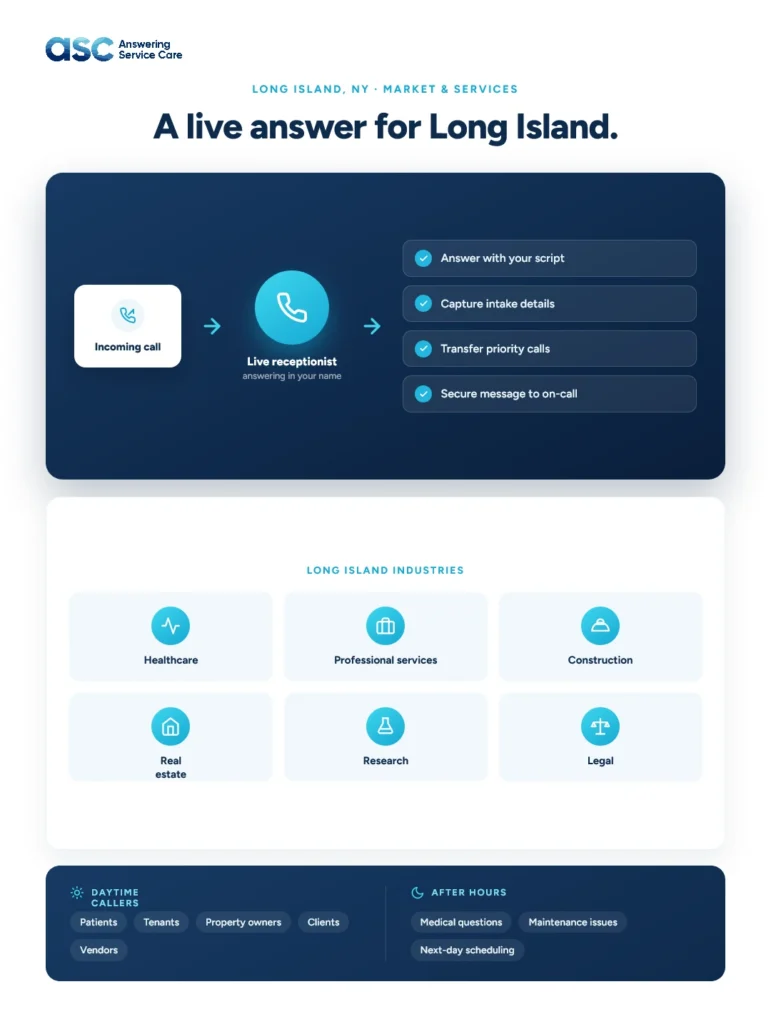
Across Long Island, daytime calls often come from patients, tenants, property owners, clients, and vendors who need a real person quickly. After hours, the pattern shifts toward more urgent matters such as medical questions, maintenance issues, and next-day scheduling requests. A live answering structure matters here because operators can answer with your script, capture intake details, transfer priority calls, and send secure messages to on-call staff based on the rules you define.
Our Long Island answering service provides 24/7 live receptionist coverage for overflow, after-hours, or full-time call handling, with scripted intake, urgent-call patch-through, and secure message delivery. Request pricing or set up coverage in as little as one business day. That gives your team a consistent intake process without tying phone coverage to a single desk, employee, or office schedule.
What Local Long Island Phone Numbers Signal to Callers
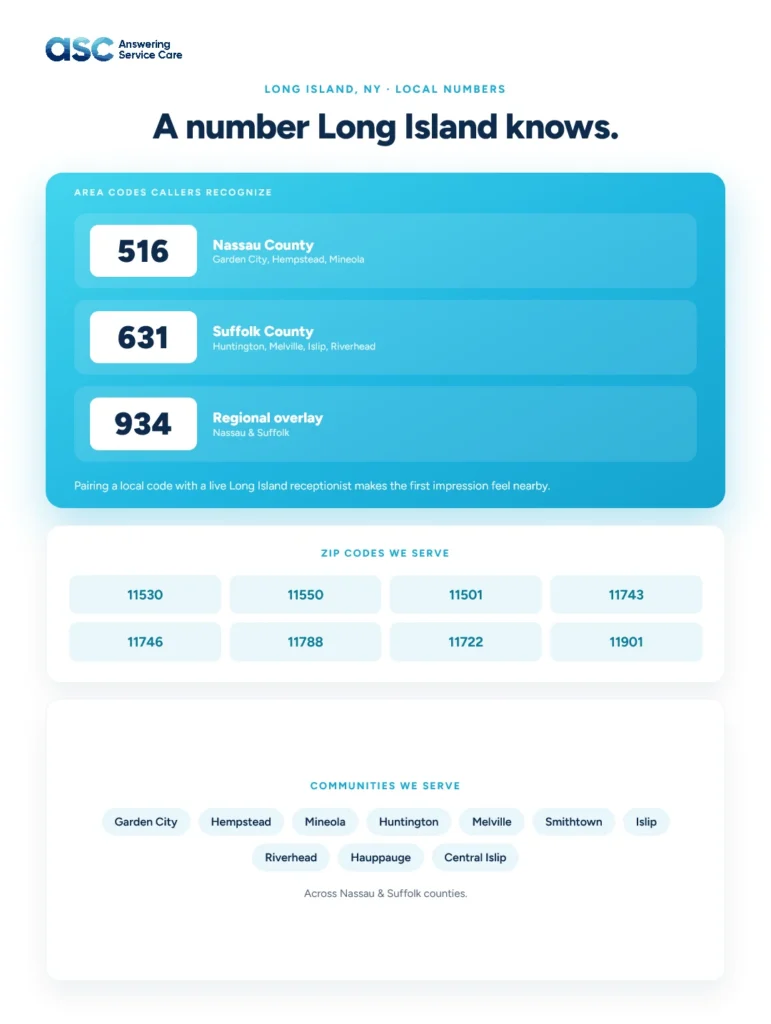
Phone numbers carry regional meaning across Long Island. Businesses in Nassau and Suffolk counties commonly use the 516, 631, and 934 area codes, which are widely recognized in communities such as Garden City, Hempstead, Mineola, Huntington, Melville, Smithtown, Islip, and Riverhead. Pairing one of these local area codes with a live Long Island virtual receptionist helps businesses create a more immediate and credible first impression for callers who want to reach someone nearby.
We support businesses across Nassau and Suffolk, including Garden City, Hempstead, Huntington, Melville, Smithtown, Islip, and Riverhead. We cover several ZIP codes, such as 11530, 11550, 11501, 11743, 11746, 11788, 11722, and 11901. These ZIP codes cover a mix of commercial centers and residential areas in Garden City, Hempstead, Mineola, Huntington, Melville, Hauppauge, Central Islip, and Riverhead, where medical practices, law offices, contractors, real estate teams, and other service providers receive regular inbound calls.
That local recognition matters when the phone rings. A live operator can answer promptly, gather the right details, and send the call or message to the appropriate person based on your instructions, helping your business feel responsive from the very first interaction.
How Long Island Office Costs Affect Front-Desk Staffing
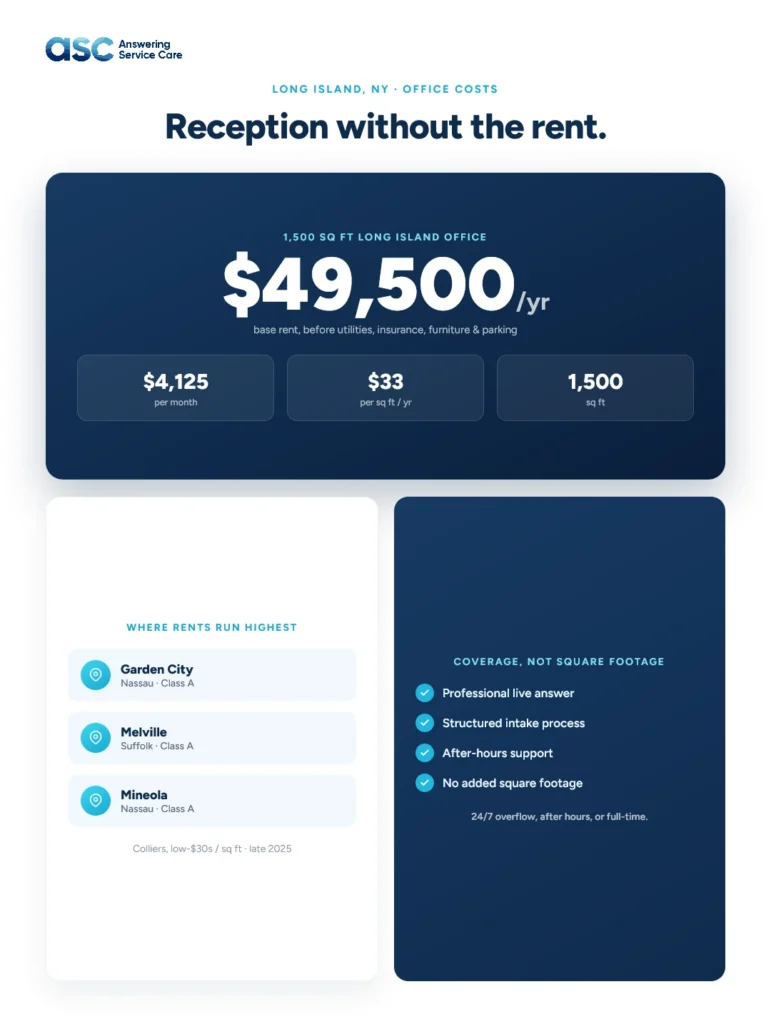
Long Island office space is expensive enough that businesses often evaluate whether every role still needs to be tied to physical square footage. In late 2025, Colliers placed Long Island office asking rents in the low-$30s per square foot, ranging from roughly $30.21 to $33.67 across quarters and sources. Nassau County and Class A products in places such as Garden City, Melville, and Mineola tend to sit toward the top of that range.
A 1,500-square-foot office leased at $33 per square foot works out to roughly $49,500 per year in base rent, or about $4,125 per month before utilities, common area charges, insurance, furniture, and parking. That cost does not flex with call volume. If your business mainly interacts with clients by phone, maintaining a staffed reception desk within that footprint can be a costly way to address what is really a communication problem.
A Long Island answering service separates phone coverage from office space. Your business can maintain a professional live answer, a structured intake, and after-hours support without dedicating additional square footage or staffing to the front desk alone.
What It Takes to Staff Phones Under New York Employment Law
Internal phone coverage on Long Island is shaped by the same New York wage and leave rules that affect the rest of the downstate labor market. New York’s minimum wage remains above many U.S. markets at $17 per hour, and employers must also account for overtime obligations under the Fair Labor Standards Act, as well as state-paid sick leave requirements when front-desk employees are out.
In practice, the challenge extends beyond paying one receptionist. Businesses also need coverage during breaks, lunch hours, sick days, vacations, and late calls without letting service quality slip. Organizations that need broader coverage often end up cross-training multiple employees or increasing administrative headcount.
That is one reason answering services remain attractive on Long Island. Instead of building a rotating coverage model internally, businesses can define transfer rules, escalation paths, and message delivery preferences once, then let operators handle routine intake and urgent routing consistently.
Reception Payroll Costs in Nassau and Suffolk Counties
The Bureau of Labor Statistics tracks Nassau-Suffolk as its own metropolitan division for labor data, underscoring that Long Island operates as a distinct employment market within the broader New York region. BLS also shows that Nassau and Suffolk county wage levels are well above those of many other New York counties, with fourth-quarter 2024 average weekly wages rising in both counties.
For employers, that means a receptionist’s cost is never just base pay. Even before benefits, taxes, and turnover are factored in, front-desk coverage on Long Island is in a relatively expensive labor market. Once you factor in overlap for breaks, absences, and after-hours response, what looks like one role can function more like a small scheduling system.
That is why many businesses compare in-house staffing to virtual receptionist coverage.

Answering Service Care plans start at $25 a month for AI and $40 for live agents, giving businesses a way to maintain live answering, intake, and escalation support without adding another full payroll line.
The Three Biggest Output Drivers Behind Long Island Call Demand
Long Island’s economy is shaped by three major forces: financial activities and real estate, health care and social assistance, and construction and manufacturing.
Financial services and property-related businesses anchor many of the region’s office corridors, while health care networks support a large share of daily operational activity across Nassau and Suffolk counties. Construction and manufacturing add a more project-driven dimension to the regional economy. Infrastructure work, facilities expansion, production schedules, supplier coordination, and field operations all contribute to a business environment where timing, responsiveness, and clear communication matter from one call to the next.
The calls tied to these sectors vary widely, but the need for fast, accurate handling remains the same. A medical practice may need appointment triage and secure message delivery. A property manager may need an emergency maintenance patch-through. A contractor may need job-site coordination, while a manufacturer may need supplier updates or service support outside standard business hours. Live Long Island virtual receptionists help keep those conversations organized in real time so your team receives clear information and callers reach the right next step quickly.

Financial services and real estate remain central to Long Island’s economy, particularly in Nassau County. The region includes institutions such as Jovia Financial Credit Union in Westbury and FourLeaf Federal Credit Union in Bethpage, as well as a broad network of insurance agencies, mortgage professionals, wealth advisors, and real estate firms serving business centers such as Garden City, Mineola, and Melville.
Long Island also has homegrown real estate brands such as Daniel Gale Sotheby’s International Realty, which was founded on Long Island and continues to serve the wider metro area through a strong residential and commercial presence. These businesses help shape a large share of the region’s office-based and property-related activity.
That concentration of finance and real estate activity shapes the kinds of calls businesses receive every day. Offices across Nassau and Suffolk handle inquiries tied to policies, claims, closings, lease questions, maintenance coordination, vendor scheduling, and client follow-up. For these firms, live answering helps keep communication organized by screening calls, capturing details, and directing them according to urgency, department, and time of day.
Health care is one of Long Island’s defining industries, anchored by major systems such as Northwell Health, Catholic Health, Stony Brook Medicine, and NYU Langone Hospital—Suffolk. Together, these organizations support hospitals, specialty practices, outpatient locations, urgent care centers, and regional referral networks across Nassau and Suffolk counties.
Northwell describes itself as New York’s largest healthcare provider serving Long Island, Catholic Health operates six hospitals across the island, and Stony Brook University Hospital identifies itself as Long Island’s premier medical center. Their scale makes healthcare one of the most visible and operationally complex parts of the regional economy.
That reach creates constant communication needs across multiple facilities and service lines. Hospitals, physician groups, outpatient centers, and home health providers manage appointments, referrals, follow-up calls, after-hours concerns, and interdepartmental and interlocation coordination. For medical clients, live answering supports appointment intake, message triage, escalation rules, and privacy-conscious communication built around HIPAA-sensitive workflows.
Construction and manufacturing give Long Island a more project-driven economic base than many regional summaries capture. On the construction side, companies such as Haugland Group, headquartered in Melville, work across civil infrastructure, energy, storm restoration, and electrical construction projects. Its Long Island presence reflects the region’s connection to utility work, transportation improvements, health system expansion, mixed-use development, and other large infrastructure jobs.
Manufacturing and technology production remain important as well. BAE Systems describes its Greenlawn site as the company’s largest aerospace and defense presence on Long Island, focused on secure communications and command-and-control technologies. Brookhaven National Laboratory also plays a major role in the island’s research and technology economy, with an emphasis on strengthening Long Island’s technology base and innovation ecosystem.
These industries depend on constant coordination between project teams, suppliers, service providers, and field operations. Calls often involve scheduling, procurement updates, site access, vendor communication, equipment service, and urgent project issues that need a fast response. Live answering helps contractors, manufacturers, and research-driven organizations keep those conversations organized without pulling managers and technical staff away from active work.
Long Island’s core industries depend on timely communication to keep work moving across Nassau and Suffolk counties. Financial and real estate firms manage client questions, closings, and property issues. Healthcare providers coordinate appointments, referrals, and follow-up needs. Construction and manufacturing teams handle scheduling, vendor communication, and job-related updates that often change throughout the day. Many of these organizations also operate in environments shaped by privacy and compliance expectations, including HIPAA requirements in healthcare and strict documentation standards in financial services.
When those conversations are delayed, the effects spread quickly. A maintenance issue may sit unresolved, a patient message may wait too long for review, or a project update may miss the person who needs it most. In regulated industries, delays can create additional problems by slowing documentation, increasing the risk of incomplete message handling, or leaving sensitive information without a clear path to the right person. Clear call handling helps prevent that kind of slowdown by giving each inquiry an immediate next step.
Long Island virtual receptionists create a dependable first point of contact the moment the phone rings. Operators answer in your company’s name, collect the details that matter, and record messages in a structured format so your team receives clear information instead of fragmented voicemails or incomplete callbacks. For healthcare, legal, and financial organizations, this process can be aligned with privacy-conscious workflows and secure message-delivery practices.
Calls can also be handled according to rules you set in advance. Priority matters can be transferred to the right contact, while routine requests can be documented and sent for follow-up. Escalation paths can be organized by issue type, department, or time of day, helping businesses respond appropriately without overloading internal staff.
Coverage can also include bilingual answering, appointment scheduling support, spam filtering, and secure message delivery for businesses that need more than basic message taking. That structure keeps communication organized, reduces interruptions, and helps callers reach a real person even when your in-house team is unavailable.
Answering Service Features That Give Long Island Businesses More Flexibility
Answering Service Care can tailor Long Island call coverage around the way your business actually operates, rather than forcing every caller through a generic script. Support can include live answering during regular business hours, overflow coverage during peak call periods, and after-hours coverage for evenings, weekends, and holidays when internal staff is unavailable.
Operators answer with your custom greeting and capture the caller’s name, callback number, address/location, issue type, urgency level, preferred appointment times, and required identifiers for industries such as healthcare and finance. Calls can be patched directly to designated contacts per your instructions, while non-urgent messages can be delivered via SMS, email, or a secure dashboard so the right people receive the right information without delay.
Coverage can also extend beyond standard message taking. Bilingual answering can help businesses communicate with a wider range of callers, while spam filtering reduces interruptions from robocalls and low-value traffic. Privacy-conscious message handling supports industries such as healthcare, legal, and financial services, and access controls can limit who can receive, view, or retrieve messages. That structure helps businesses keep communication organized, responsive, and confidential throughout the workday.

Our Long Island answering service gives businesses across Nassau and Suffolk counties a way to manage incoming calls without adding more in-house staff or stretching current teams too thin. Coverage can be built around the way your business operates and may include:
- live answering during regular hours, high-volume periods, and after-hours windows
- custom call greetings and intake workflows tailored to your process
- direct transfers for urgent matters and tiered escalation paths
- appointment booking support and structured new caller intake
- bilingual answering when needed
- spam and robocall screening
- secure message delivery through SMS, email, or dashboard tools
- privacy-conscious handling for healthcare, legal, and financial communication
At Answering Service Care, each call is answered by a live operator, recorded in a clear format, and delivered according to your instructions so your team can stay focused on client work, scheduling, and day-to-day operations.
Coverage Across Nassau and Suffolk Counties
Different parts of Long Island produce different call patterns. A Huntington medical office may need evening scheduling requests logged for next-day review. A Melville law office may want all new leads captured, but only true emergencies patched through. A property manager in Islip may need weekend maintenance escalation tied to an on-call rotation. A contractor in Brookhaven may need job-site updates sent to a supervisor immediately, while a real estate office in Garden City may want inquiries sorted by buyer, seller, rental, or urgent tenant issue.
Answering Service Care supports organizations across Long Island, including Hempstead, Garden City, Mineola, Huntington, Melville, Smithtown, Islip, Brookhaven, and Riverhead. Coverage can be tailored to each business’s operations, whether that means overflow during business hours, full after-hours answering, weekend support, or a combination of all three. Call handling can also be adjusted by department, urgency level, escalation path, and message-delivery method so the service fits the pace and structure of your operation.
Call details can be documented in secure systems and delivered only to authorized contacts through controlled channels, helping businesses protect confidentiality while still keeping the right people informed quickly. That is especially important for organizations handling sensitive medical, legal, financial, or client service information that cannot be left to voicemail or delayed until the next day.
Simple Call Routing Options for Long Island Businesses
Long Island businesses commonly use national wireless carriers such as Verizon, AT&T, and T-Mobile, each of which provides official coverage maps and call-forwarding options for mobile lines. For office and bundled communications, Optimum Business is also a major provider on Long Island, offering business internet and phone services from its Long Island base.
That matters because call forwarding does not require a new public-facing number. Businesses can keep the number that customers already know and route calls to a live answering service full-time, after hours, or only during overflow periods. The result is a cleaner caller experience and more flexible internal coverage.