
Syracuse Answering Service

Serving Syracuse, NY, and the broader Central New York region, our answering service supports local businesses with consistent live call handling tied to your existing number.
Syracuse supports a regional economy centered on healthcare, higher education, government services, and professional operations that serve Central New York. While the city was historically driven by manufacturing, its current economic base is built around institutions and service providers that rely on consistent, real-time communication to operate effectively. Hospitals, universities, public agencies, and service businesses all depend on inbound calls to manage scheduling, intake, coordination, and ongoing client or patient interaction.
Across Syracuse, daytime calls often come from patients, tenants, property owners, clients, and vendors who need direct assistance without delay. After hours, call patterns shift toward more urgent matters such as medical concerns, maintenance issues, and next-day scheduling requests. In both cases, callers expect to reach a live person who can respond immediately and provide a clear next step.
Our 24/7 Syracuse, NY answering service provides live receptionist coverage for overflow, after-hours, or full-time call handling, so every call is answered by a real person. Operators answer using your script, capture structured intake details, transfer priority calls based on urgency, and deliver secure messages to your team. This creates a consistent intake process without tying phone coverage to a single employee, desk, or office schedule.

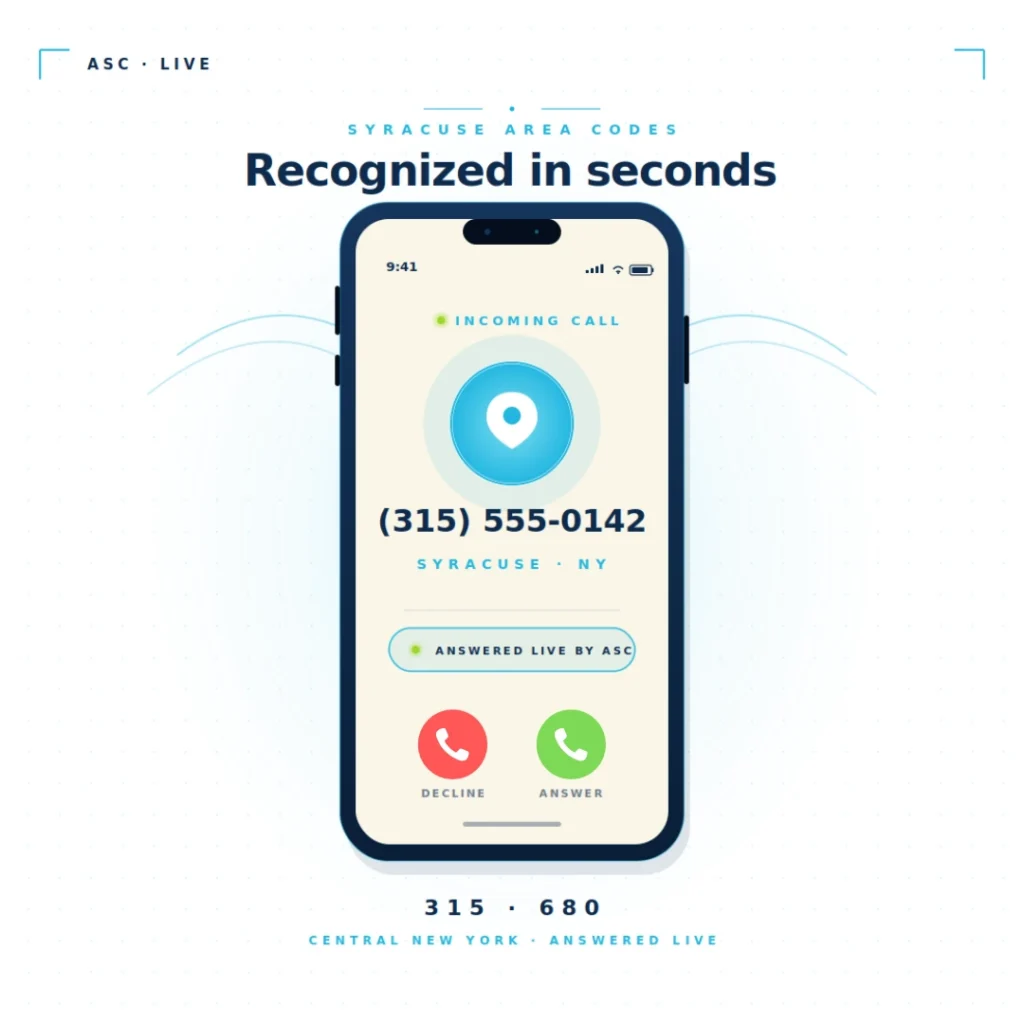
Why a Local 315/680 Syracuse Number Increases Answer Rates and Caller Trust
Phone numbers carry regional meaning throughout Central New York. Businesses in Syracuse primarily use the 315 area code, along with the 680 overlay, both of which are widely recognized across the region and signal a local presence to callers.
Pairing one of these area codes with a Syracuse virtual receptionist helps create a stronger first impression. Callers are more likely to stay on the line when they believe they are reaching a nearby office rather than an automated system or remote call center. That familiarity plays an important role in industries where trust influences whether a caller shares details or continues the conversation.
We support businesses across Syracuse and surrounding communities, including Downtown, University Hill, East Syracuse, Liverpool, North Syracuse, and DeWitt. Coverage includes ZIP codes such as 13202, 13203, 13204, 13205, 13206, 13207, 13208, 13210, 13214, 13224, and 13290, which represent a mix of medical districts, university areas, commercial corridors, and residential neighborhoods where inbound call activity remains steady.
That local recognition matters when the phone rings. A live operator can answer promptly, gather the right details, and route calls or messages based on your instructions, helping your business feel responsive from the first interaction.
How Office Costs in Syracuse Influence Front Desk Strategy
Office space in Syracuse is more affordable than in major metro markets, but it still influences how businesses structure their operations. Across Downtown Syracuse, University Hill, and surrounding office corridors, asking rents typically range from $18 to $24 per square foot, depending on building class and location.
A 1,500-square-foot office leased at $20 per square foot equates to roughly $30,000 annually, or about $2,500 per month before utilities, maintenance, insurance, and workspace setup. While this is lower than in downstate markets, it remains a fixed cost that does not adjust with call volume or usage.
For many Syracuse businesses, especially in healthcare, legal, and service-based industries, client interaction most often occurs over the phone rather than in person. Maintaining a staffed reception desk within that footprint can become a costly way to manage what is primarily a communication function.
A Syracuse answering service separates phone coverage from office space. Businesses can maintain a live answer, structured intake, and after-hours support without dedicating additional square footage or internal staffing to a front desk role.

What It Takes to Maintain Consistent Phone Coverage in Syracuse
Internal phone coverage in Syracuse is shaped by both operational needs and New York labor requirements. Businesses must provide consistent coverage throughout the workday while accounting for breaks, lunches, sick leave, vacations, and after-hours calls, without compromising service quality.
New York State wage laws play a direct role in this structure. As of 2026, the minimum wage across most of the state, including Syracuse, is $16.00 per hour. Employers must also comply with federal overtime requirements and provide paid sick leave based on hours worked, which adds to the overall cost and complexity of staffing front desk roles.
At the same time, Syracuse’s workforce presents a unique dynamic. The city has a lower labor force participation rate and higher unemployment than the surrounding areas, yet it remains the region’s primary employment center. A large share of jobs is concentrated within the city, with many workers commuting into Syracuse each day.
This combination creates steady demand for communication while challenging the ability to maintain consistent staffing. Businesses often rely on multiple employees or cross-trained staff to avoid coverage gaps.
That is one reason answering services remain practical. Instead of managing rotating schedules internally, businesses can define intake rules, escalation paths, and message delivery preferences once, then rely on operators to handle calls consistently.
Reception Payroll in Syracuse and What It Means for Your Business
Reception payroll costs in Syracuse are lower than in larger New York markets, but they still represent a meaningful expense when viewed in full. According to regional labor data, receptionists in upstate New York typically earn between $16 and $20 per hour, depending on experience and industry.
At $18 per hour, a full-time receptionist working 40 hours per week earns approximately $37,400 annually in base wages. Once payroll taxes, unemployment insurance, and basic benefits are included, total employment cost can exceed $45,000 per year. If coverage is needed during evenings, weekends, or high-volume periods, additional staff may be required, further increasing total payroll.
Coverage also does not remain static. Breaks, absences, turnover, and seasonal demand can require overlapping schedules or backup staff, turning what appears to be a single role into a multi-person system.
That is why many Syracuse businesses compare in-house staffing to virtual receptionist coverage.

Answering Service Care plans start at $25 a month for AI and $40 for live agents (based on plan type and call volume). We’ll recommend a tier based on your hours, average call length, and whether you need transfers, scheduling, or bilingual support.
How Syracuse’s Economy Influences Daily Call Activity
Syracuse’s economic activity centers around three key areas: health systems and universities, public-sector and institutional operations, and a growing base of advanced manufacturing and infrastructure work. Hospitals and academic institutions generate continuous interaction tied to care, enrollment, and administration, while government-related services support a wide range of programs and public-facing operations. At the same time, newer investments in manufacturing and infrastructure introduce a more operational and coordination-heavy layer, with activity tied to construction timelines, utilities, logistics, and technical production.
The nature of incoming calls reflects that mix. A clinic may need patient information recorded and routed to the right provider. An academic office may field scheduling or departmental inquiries. A municipal department may need service requests documented and directed. A contractor or supplier may call with updates that affect active field work. Each situation is different, but the expectation is the same. The caller needs a clear response and a defined next step. Live answering keeps those interactions organized, so information moves quickly and nothing stalls between the initial call and the action that follows.

Health systems and universities form the backbone of Syracuse’s employment base, with institutions such as SUNY Upstate Medical University, Syracuse University, St. Joseph’s Health, and Crouse Hospital shaping a large share of the city’s daily activity. These organizations operate across campuses, hospitals, specialty practices, and administrative offices that extend throughout University Hill and the surrounding areas.
Their scale creates a continuous stream of communication that ties into both clinical and administrative functions. Medical offices manage appointment requests, patient questions, referrals, and follow-up care, while academic departments handle enrollment inquiries, scheduling, and internal coordination across faculty and staff. Many of these interactions involve multiple departments, making clear intake and routing essential.
For organizations in this space, live answering provides a structured way to manage that volume. Calls can be documented, prioritized, and directed to the appropriate department without delay, helping maintain continuity across both patient care and academic operations.
For healthcare and higher education, Answering Service Care offers:
- patient appointment scheduling and rescheduling requests
- referral coordination between providers and departments
- prescription or follow-up message intake for clinical staff
- student inquiries related to scheduling, offices, or services
- administrative call routing across campuses and care facilities
Public-sector and institutional employment continues to play a major role in Syracuse’s economy, supporting a wide range of services connected to healthcare, education, and community programs. Local, state, and federal operations sustain a steady flow of administrative and service-related activities across the region.
Facilities such as the Syracuse VA Medical Center and other government-supported systems operate alongside municipal departments and public agencies, each handling inquiries tied to services, documentation, and coordination. These organizations often manage communication across multiple offices, with calls involving scheduling, eligibility questions, program support, and internal routing.
Because these systems serve a broad population and operate across layered administrative structures, communication must be clear and organized. Live answering supports that process by ensuring each call is recorded accurately and directed to the appropriate contact, helping maintain consistency across departments.
For government and institutional services, Answering Service Care offers:
- public service inquiries and program-related questions
- eligibility verification requests and documentation follow-up
- interdepartmental message routing across agencies
- scheduling for appointments, hearings, or service visits
- intake for community requests and non-emergency service needs
Syracuse’s economic landscape is evolving with renewed investment in advanced manufacturing and large-scale infrastructure. While traditional manufacturing has declined, new development is reshaping the region’s industrial base with a focus on technology, energy, and production systems.
Micron Technology’s planned semiconductor complex in Clay represents a significant expansion, with long-term job creation and supply chain growth expected to influence the broader region. At the same time, established companies such as Carrier, Lockheed Martin, SRC, and National Grid continue to support engineering, defense, energy, and utility operations across Central New York.
These industries rely on ongoing coordination between teams, contractors, suppliers, and field operations. Communication often centers on scheduling, project updates, service requests, and operational changes that require quick attention.
Live answering helps manage that flow by capturing details, organizing requests, and ensuring information reaches the right person without interrupting technical or field-based work.
For advanced manufacturing and infrastructure growth, Answering Service Care offers:
- vendor and supplier coordination updates
- job-site communication and field team dispatch requests
- equipment service calls and maintenance scheduling
- logistics updates tied to shipments, deliveries, or materials
- internal coordination between operations, engineering, and support teams
Syracuse’s business environment is built around institutions and service providers that depend on steady, organized communication throughout the day. Healthcare offices manage patient inquiries and scheduling, universities handle administrative and departmental coordination, and service businesses respond to requests that often require a same-day or next-day response. Many of these operations involve multiple people, departments, or locations, which makes how information is received and passed along just as important as the call itself.
Gaps in that process tend to create confusion rather than just delay. A message may reach the wrong department, lack key details, or require follow-up to clarify the original request. In environments that rely on accurate documentation or time-sensitive coordination, such a breakdown can affect both internal workflows and the caller’s experience. A structured intake process helps prevent those issues by capturing complete information at the start and directing it appropriately.
Syracuse virtual receptionists provide a consistent point of entry for incoming calls. Each call is answered in your business name, and operators record details in a clear, usable format so your team can act on the information without needing to reconstruct the conversation. This approach is especially useful for organizations that handle high call volumes or operate across multiple roles and responsibilities.
When calls come in, we: (1) answer in your business name, (2) follow your script, (3) capture caller + issue details, (4) determine urgency, (5) transfer/escalate if needed, (6) deliver the message via SMS/email/portal.
Call handling can be shaped around how your business operates. Urgent situations can be routed directly to the appropriate contact, while routine inquiries can be logged and delivered for follow-up. Workflows can be organized by department, call type, or time of day, giving you control over how communication moves through your organization.
Support can also include bilingual answering, appointment intake, filtering out unwanted calls, and secure message delivery when needed. This structure keeps communication organized and ensures that callers reach a live person who can move the interaction forward without adding friction for your internal team.
Answering Service Features Designed Around Your Workflow
Answering Service Care can tailor Syracuse call coverage to your business’s operations. Support can include live answering during business hours, overflow coverage during peak call periods, and after-hours answering for evenings, weekends, and holidays.
Our answering service offers:
Call Handling & Workflow
- live answering coverage windows
- custom greetings and intake steps
- urgent call transfers
- escalation paths by priority or department
Communication & Delivery
- SMS and email message delivery
- secure dashboards or portals
- bilingual answering
- spam filtering
Additional features may include bilingual answering, spam filtering, appointment intake, and privacy-conscious message handling for industries such as healthcare, legal, and financial services. This structure helps keep communication organized and responsive without adding internal complexity.
Our Syracuse answering service gives businesses across Central New York a reliable way to manage inbound calls without expanding internal staff or overloading existing teams. Coverage can be configured around how your business operates and adjusted based on timing, volume, and priority. Support may include:
- live call handling during business hours, peak periods, and after-hours coverage
- personalized greetings and intake processes aligned with your internal workflow
- immediate call transfers for urgent situations and structured escalation routing
- appointment scheduling assistance and organized intake for new callers
- bilingual support to accommodate a broader range of callers
- filtering of spam and unwanted robocalls to reduce interruptions
- message delivery through SMS, email, or secure access portals
careful handling of sensitive information for healthcare, legal, and financial communication
Each call is answered by a live operator, documented clearly, and delivered according to your instructions so your team can stay focused on client work, scheduling, and daily operations without disruption.

Yes. We provide a 24/7 live answering service in Syracuse, NY for after-hours, weekends/holidays, and overflow during busy periods. A live receptionist answers every call, follows your instructions, and ensures callers get a clear next step instead of voicemail.
Yes. Our Syracuse virtual receptionists answer in your business name and follow your custom greeting, script, and intake questions. We capture the exact details you request (caller info, reason for calling, urgency, and scheduling notes) and send clean, consistent messages to your team.
Yes. We can transfer urgent calls and follow your on-call escalation rules by call type and severity. You define what counts as urgent, who gets called first, and when to escalate, so time-sensitive Syracuse calls reach the right person quickly.
Messages can be delivered via SMS, email, and/or a secure portal, depending on your workflow. We can route by department, call category, time of day, or Syracuse-area location/service area so the right contact receives the message without delays.
Yes. We support confidentiality-sensitive call handling with approved scripts, minimum-necessary intake, and controlled message routing. If your Syracuse practice requires HIPAA-specific setup (such as a BAA), confirm this during onboarding so delivery methods and access controls align with your compliance needs.
Frequently Asked Questions (FAQ's)
Supporting Businesses Across Syracuse and Central New York
Different areas of Syracuse result in different types of incoming calls. A practice near University Hill may need evening patient inquiries recorded and prepared for the next day. A contractor in East Syracuse may require time-sensitive updates to be routed directly to a project lead. A property manager in Liverpool may rely on weekend call handling to coordinate maintenance requests, while a law office Downtown may want new client inquiries documented and prioritized based on urgency.
Answering Service Care works with businesses throughout Syracuse, including Downtown, University Hill, East Syracuse, DeWitt, Liverpool, North Syracuse, and nearby communities. Coverage can be structured around how each organization operates, whether that involves daytime overflow, full after-hours support, weekend coverage, or a combination of all three. Call handling can also be organized by department, priority level, escalation rules, and delivery method, aligning with your internal workflow.
Call information is captured in a clear, organized format and delivered only to the appropriate contacts through secure channels. This helps businesses maintain control over communication while ensuring that important details reach the right person without delay, particularly in environments where accuracy and confidentiality are essential.

How Call Forwarding Works for Syracuse Businesses Without Changing Your Number
Syracuse businesses typically rely on carriers such as Verizon, AT&T, and T-Mobile, as well as VoIP platforms and regional providers, all of which offer straightforward call forwarding options. Setting up forwarding does not require changing your existing number. Your current business line stays the same while calls are redirected behind the scenes.
Using simple call-forwarding instructions or following a step-by-step call-forwarding guide, businesses can decide exactly when and how calls are handled. Calls can be routed to a live answering service during peak hours, after hours, or only when lines are busy, giving you control over coverage without disrupting your current setup.
This approach keeps your number consistent for customers while improving how calls are managed internally. It creates a smoother caller experience and gives your team the flexibility to adjust coverage as demand changes.
- SYR Area Codes and Hometown Identity
- In-House Reception Expenses Across SYR
- New York Labor Laws for SYR Call Handling
- Front Desk Salaries in Greater SYR
- Top Sectors Behind SYR Inbound Traffic
- The Case for Live Agents in SYR Companies
- Tailored Call Coverage for SYR Operations
- Service Reach Through SYR and Onondaga County
- Routing Inbound Calls for SYR Companies