
Fort Worth Answering Service


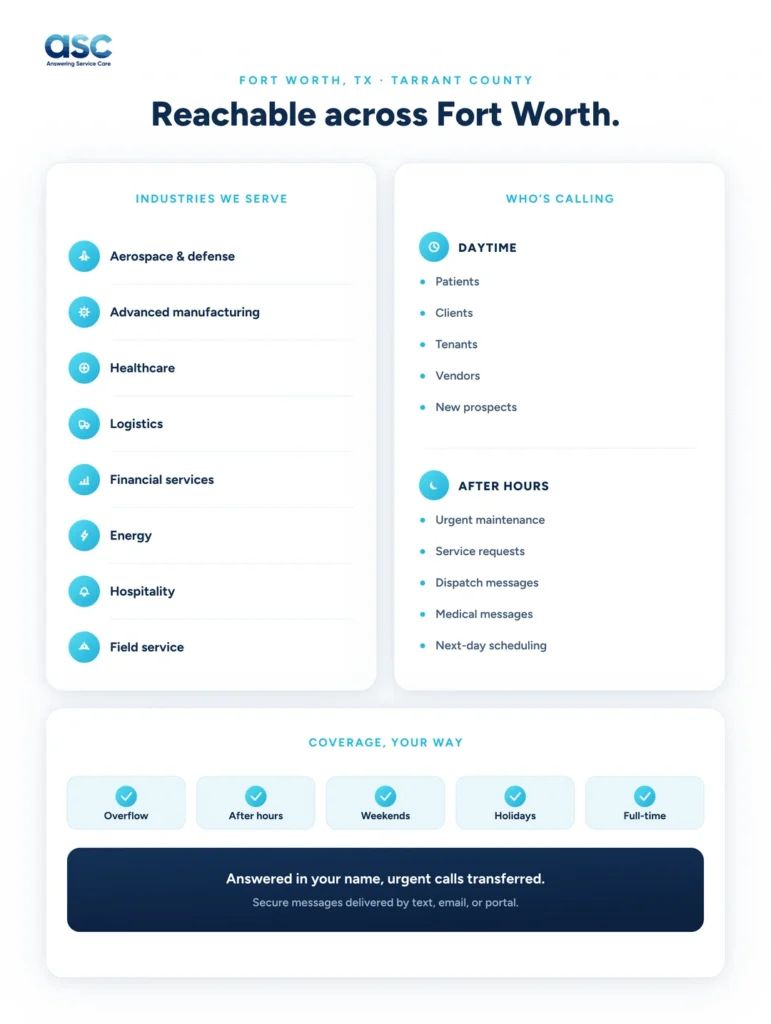
Serving Fort Worth, TX, and the surrounding Tarrant County region, our answering service helps local businesses stay reachable while continuing to use the phone number their customers already know. Fort Worth has a business environment shaped by aerospace and defense, advanced manufacturing, healthcare, logistics, financial services, energy, hospitality, and field-based service operations. That mix creates a steady flow of inbound calls tied to appointments, new leads, vendor coordination, dispatch needs, property issues, patient questions, customer follow-up, and after-hours support.
Across Fort Worth, daytime calls often come from patients, clients, tenants, customers, vendors, suppliers, and new prospects who want a clear answer or next step. After hours, call patterns often shift toward urgent maintenance concerns, service requests, dispatch-style messages, medical messages, reservation questions, and scheduling needs that still need to be documented while internal staff are unavailable. In both cases, callers expect to reach a person who can respond clearly, capture the right information, and keep the interaction moving.
Our 24/7 Fort Worth, TX answering service provides live receptionist coverage for overflow, after-hours, weekends, holidays, or full-time call handling. Operators answer in your business name, follow your script, capture structured intake details, transfer urgent calls when appropriate, and deliver secure messages to the right members of your team.
Local 817 and 682 Numbers Give Fort Worth Callers a Familiar Starting Point
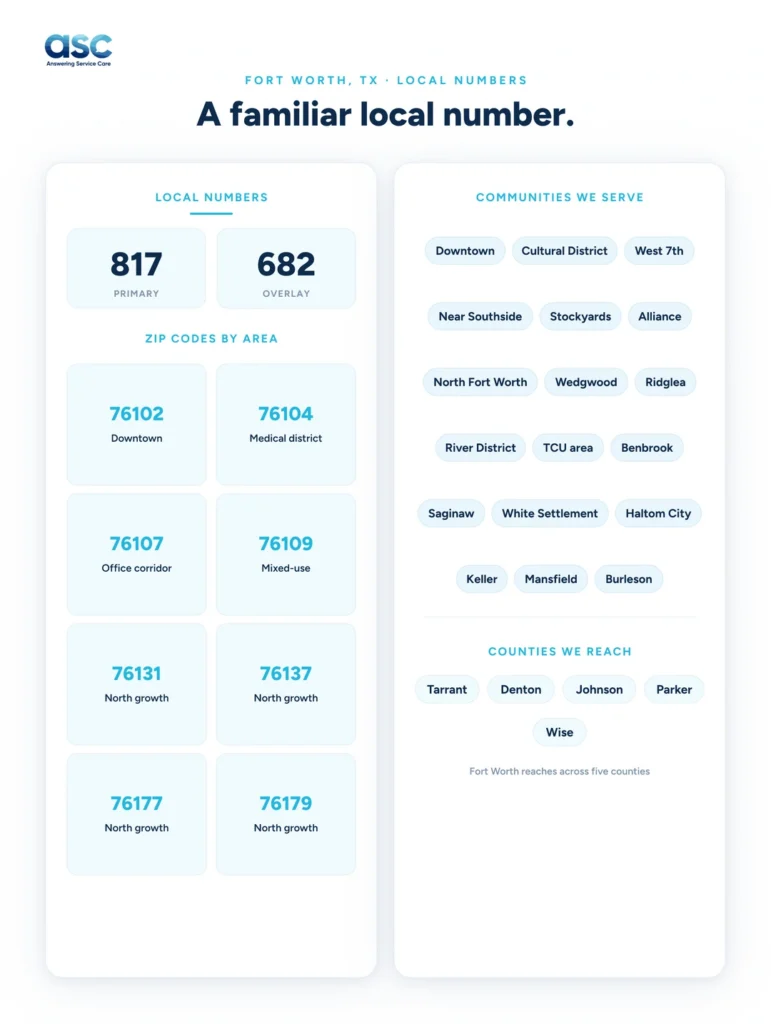
Local phone numbers still matter in Fort Worth. The 817 and 682 area codes are strongly associated with Fort Worth and much of the surrounding Tarrant County market. For businesses that depend on local trust, those numbers can help signal that the company is connected to the area callers already know.
That recognition matters when customers are deciding whether to stay on the line, leave a voicemail, or choose another option. A Fort Worth number can reinforce that your business understands the local market, serves nearby neighborhoods, and is prepared to respond to callers in the community.
ZIP coverage matters for the same reason. Fort Worth ZIPs include business-heavy areas such as 76102 downtown, 76104 around the medical district, 76107 and 76109 near core office and mixed-use corridors, and growing service areas like 76131, 76137, 76177, and 76179 farther north. Fort Worth is based in Tarrant County but extends into Denton, Johnson, Parker, and Wise counties, which means call handling often needs to reflect different neighborhoods, service territories, and county-level coverage expectations rather than a single static front desk.
We support businesses across Fort Worth and nearby Tarrant County communities, including Downtown Fort Worth, the Cultural District, West 7th, the Near Southside, the Stockyards, Alliance, North Fort Worth, Wedgwood, Ridglea, River District, TCU-area neighborhoods, Benbrook, Saginaw, White Settlement, Haltom City, Keller, Mansfield, Burleson, and other surrounding service areas. Coverage can also be organized around the neighborhoods, routes, properties, clinics, offices, or territories your team already serves.
Rethinking Reception Coverage in Fort Worth’s Office Market
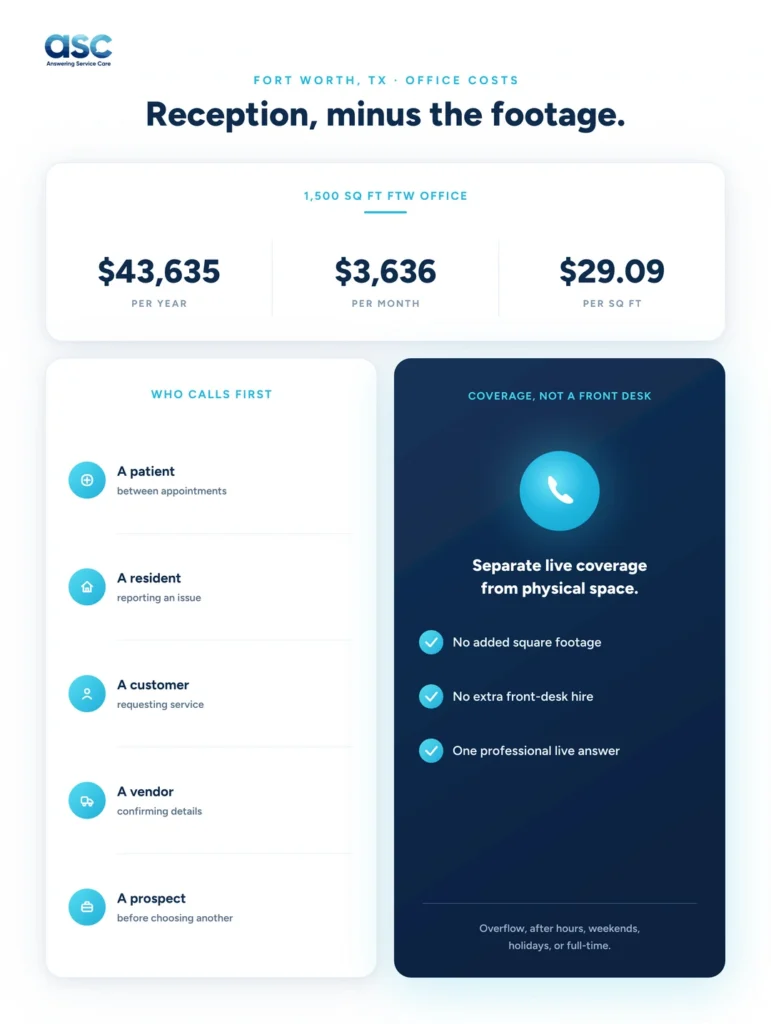
Fort Worth office costs continue to affect how local businesses think about staffing, space, and front desk operations. Recent local market reporting placed Fort Worth’s average direct asking rent at about $29.09 per square foot. A 1,500-square-foot office leased at that rate comes to about $43,635 per year, or roughly $3,636.25 per month, before utilities, furnishings, parking, equipment, insurance, maintenance, and other occupancy costs are added.
For many Fort Worth businesses, that raises a practical question: how much office space should be tied to reception coverage, given that many important first interactions now happen by phone?
In Fort Worth, the first point of contact is often not someone walking into a lobby. It may be a patient calling between appointments, a property resident reporting an issue, a customer requesting service, a vendor confirming details, or a prospect trying to reach someone before choosing another provider. A Fort Worth answering service separates live call coverage from physical front desk space, helping businesses maintain a professional live answer without expanding square footage or relying on a single in-house employee to handle every call.
Why Fort Worth Businesses Need Phone Coverage Beyond One Desk
Keeping phones answered in Fort Worth usually takes more planning than assigning the task to a single receptionist. Employees need breaks, lunches, time off, and backup during meetings or busy periods. In many Fort Worth businesses, staff are also split between offices, properties, clinics, job sites, warehouses, service routes, and customer-facing work.
Texas follows the federal minimum wage rate, but that figure does not reflect what Fort Worth employers typically need to pay to hire dependable administrative staff in a competitive market. Real coverage costs are shaped by wages, payroll taxes, paid time off, training, turnover, supervision, and the need for backup when call volume rises or employees are unavailable.
Fort Worth also has workdays that do not always fit neatly into a standard schedule. Aerospace suppliers may have early operational calls. Medical offices may receive patient concerns after hours. Property teams may need weekend maintenance intake. Contractors and field service companies may still be working while office staff have left for the day.
That is why an answering service can make sense for Fort Worth businesses. Instead of rebuilding the phone plan every time schedules change, companies can set clear instructions for intake, urgency, transfers, and message delivery, then keep calls moving through a consistent process.
What Full-Time Reception Support Can Cost in Fort Worth
Reception coverage can look straightforward at first, but the full cost is higher once wages, taxes, leave, training, and backup coverage are included. Current wage data for receptionists and information clerks in the local labor market shows annual pay around the mid-$30,000 range for a full-time role before added employment costs.
At roughly $36,600 per year in base wages, a full-time receptionist still does not account for payroll taxes, unemployment insurance, paid leave, benefits, onboarding, supervision, turnover, or the cost of someone else answering calls when that employee is at lunch, out sick, on vacation, or already helping another caller. Once those factors are included, reliable in-house phone coverage can become more expensive than the base wage suggests.
Coverage also rarely stays within one neat schedule. Lunch breaks, absences, seasonal spikes, after-hours calls, and longer service windows can turn one front desk role into a broader coverage system. That is why many Fort Worth businesses compare in-house reception staffing with virtual receptionist coverage rather than assuming internal coverage is always the simpler option.

Answering Service Care plans start at $40 per month, with the right plan depending on your call volume, hours, average call length, transfer needs, scheduling requirements, and whether you need bilingual support.
What Drives Call Volume Across Fort Worth Businesses
Fort Worth’s economy creates a call environment shaped by aerospace and defense, advanced manufacturing, logistics, healthcare, financial services, energy, hospitality, tourism, and local service work. These industries differ, but the caller’s expectation is often the same: they want a live answer, a clear next step, and confidence that their message reached the right person.
Patients call to schedule or reschedule appointments. Suppliers look for confirmation that updates were received. Property residents report urgent issues that need to be logged. Logistics contacts send time-sensitive details to operations. Visitors ask for booking information, while prospective clients are often deciding whether your business is organized enough to respond.
Live answering helps create that structure at the first point of contact. Instead of letting calls interrupt staff or fall into voicemail, businesses can route calls through a defined intake process that captures details, assesses urgency, and moves the call to the next step.

Healthcare plays an important role in Fort Worth’s local economy and daily call environment. The city’s medical district is one of the clearest local cases for structured phone coverage and includes institutions such as JPS Health Network, Texas Health Harris Methodist Hospital Fort Worth, Cook Children’s, Baylor Scott & White All Saints, TCU, UNT Health, and the TCU-UNTHSC School of Medicine. That concentration creates constant phone traffic around appointments, referral questions, follow-up messages, nurse triage handoffs, and on-call escalation.
For medical offices, the phone is often tied directly to patient access. Callers need help scheduling appointments, changing existing visits, asking referral questions, leaving messages for providers, confirming office instructions, or reporting after-hours concerns. These calls require clear documentation because missing details can lead to delayed follow-up, repeated calls, and extra work for already-busy staff.
Live answering gives Fort Worth healthcare offices a more reliable front end for patient communication. Calls can be answered in the practice name, documented in a consistent format, prioritized by urgency, and delivered through the appropriate channel. That helps internal teams stay focused on care, administration, and in-office responsibilities while callers still reach a live person.
For Fort Worth healthcare and medical offices, Answering Service Care can support:
- appointment requests, cancellations, and rescheduling
- new-patient inquiry capture
- referral and intake message documentation
- after-hours message handling for urgent concerns
- routing across providers, departments, or office locations
- HIPAA-conscious message handling and secure delivery options
Fort Worth is a major logistics and transportation market, supported by AllianceTexas, Perot Field Fort Worth Alliance Airport, nearby DFW Airport access, rail infrastructure, distribution operations, and regional highway connections. AllianceTexas contributed $16.3 billion to the state's GDP and supported about 137,000 jobs in 2024, underscoring how much of the local economy depends on movement, coordination, and operational communication. Local anchors such as BNSF Railway and Ben E. Keith also reflect the strength of Fort Worth’s transportation, logistics, and distribution activity.
That environment creates a call pattern where timing matters. Incoming calls may involve carrier questions, dock timing, load changes, route changes, delivery updates, vendor messages, service requests, maintenance issues, dispatch details, or urgent operational exceptions. If a message is missed or documented poorly, the delay can affect schedules, crews, deliveries, and customer response.
Live answering helps Fort Worth logistics and field-based businesses keep those calls organized without pulling supervisors, dispatchers, warehouse teams, drivers, or technicians away from active work. Operators can capture key details, identify urgency, and send the message to the right contact based on your process.
For Fort Worth logistics, transportation, and field operations, Answering Service Care can support:
- dispatch-style message intake
- vendor and supplier coordination updates
- delivery, shipment, and route-change messages
- maintenance and service-call scheduling
- urgent transfer rules for time-sensitive issues
- communication between field teams, office staff, and management
Real estate, construction, development, property management, and home services are strong fits for live answering in Fort Worth, as they generate frequent calls that often require quick documentation or escalation. Dallas Fed research identifies real estate, construction, and development as one of Fort Worth’s larger and faster-growing clusters, with names such as D.R. Horton and Acme Brick tied to the market. In a city that spans multiple counties and a wide range of ZIP codes, that translates into steady phone activity for builders, brokers, property managers, HVAC companies, plumbers, electricians, restoration firms, and other service businesses that work across neighborhoods rather than from a single fixed point.
These calls often involve immediate needs, but not all of them require the same response. Residents report maintenance problems. Homeowners request estimates or appointments. Tenants call after hours about urgent building issues. Contractors coordinate with vendors, crews, or customers. Property teams need clear records of what happened, when it happened, who called, and what action should come next.
Live answering helps these businesses stay responsive without requiring staff to constantly monitor the phone. Routine calls can be logged for follow-up, while urgent issues can be transferred or escalated according to your instructions. That structure is especially useful for companies covering multiple properties, job sites, neighborhoods, service routes, or after-hours responsibilities.
For Fort Worth real estate, property management, construction, and home service businesses, Answering Service Care can support:
- tenant and resident maintenance intake
- after-hours escalation for urgent property issues
- appointment and estimate request capture
- dispatch-style routing for technicians or field crews
- vendor and subcontractor message coordination
- call documentation by property, service area, issue type, or urgency
Why Fort Worth Businesses Put So Much Weight on the First Answer
Fort Worth businesses often need calls answered quickly, documented accurately, and routed to the correct person without unnecessary back-and-forth. Medical offices manage patient questions and appointment changes. Property managers handle tenant and maintenance concerns. Contractors and service companies coordinate with field teams. Professional offices manage new inquiries and client follow-up. Hospitality businesses need to keep calls moving while staff are busy with guests.
When that first interaction is inconsistent, the issue usually spreads. A message may be incomplete, routed to the wrong person, or missing the urgency needed for the team to act. Staff may need to call the customer back just to clarify the situation, which slows down both the business and the caller.
Fort Worth virtual receptionists provide a steadier starting point. Calls are answered in your business name, details are documented in a usable format, and urgent matters are escalated in accordance with your instructions. This is especially useful for businesses with steady call volume, several departments, multiple locations, on-call staff, or employees who are not always sitting at one desk.
When calls come in, we: (1) answer in your business name, (2) follow your script, (3) capture caller and issue details, (4) identify urgency, (5) transfer or escalate when needed, and (6) send the message by text, email, app, or secure portal.
Call handling can also be shaped around the way your company already works. Priority matters can go directly to the right contact, while routine calls can be logged for follow-up. Workflows can be organized by department, property, service area, schedule, call type, or urgency level, giving your team more control over how communication moves through the business.
Support can also include bilingual answering, appointment intake, unwanted call filtering, and secure message delivery when needed. That structure helps keep communication clear and organized while making sure callers reach a live person who can move the conversation forward.
Answering Service Tools Built for Fort Worth Workflows
Call handling should match the way your Fort Worth business operates, whether calls need to be sorted by urgency, department, property, route, service line, or time of day. A medical practice, an aerospace supplier, a property management company, a logistics operation, a law office, and a hospitality business will not all need the same phone workflow.
Answering Service Care can tailor Fort Worth call coverage around your business’s needs. Support can include live answering during business hours, overflow coverage during busy periods, and after-hours answering for evenings, weekends, and holidays.
Our answering service offers:
- live answering built around your hours
- branded greetings and tailored intake flow
- immediate transfers for urgent situations
- call routing based on urgency, team, department, or function
- message delivery by text, email, app, or secure portal
- secure online access to call records
- multilingual support for incoming callers
- screening for spam and unwanted calls
Additional features may include appointment intake, scheduling support, on-call routing, and privacy-conscious message handling for healthcare, legal, financial, and other sensitive communication. This helps keep communication organized without adding more internal complexity.

How a Fort Worth Answering Service Fits Into Daily Operations
A Fort Worth answering service gives businesses a reliable way to manage inbound calls without expanding internal staff or diverting employees from their core work. Coverage can be adjusted based on timing, volume, and call priority, making it easier to support both routine communication and urgent situations.
Support may include:
- live answering during regular hours, heavy call periods, evenings, weekends, and holidays
- business-name greetings and intake steps shaped around your internal process
- direct transfers for urgent matters with clear escalation rules in place
- scheduling support and structured intake for prospective callers
- multilingual answering for businesses serving a wider caller base
- screening that cuts down on spam and robocall interruptions
- message delivery by text, email, app, or secure online access
- thoughtful handling of confidential details in healthcare, legal, and financial settings
Each call is answered by a live operator, documented clearly, and delivered according to your instructions so your team can stay focused on client work, service delivery, field operations, guests, patients, and daily business priorities.
Frequently Asked Questions:
Yes. We provide 24/7 live answering for Fort Worth businesses that need support after hours, on weekends, during holidays, or when daytime call volume spikes. Instead of sending callers to voicemail, a live receptionist answers, follows your instructions, and helps move the conversation in the right direction.
Yes. Our Fort Worth virtual receptionists answer in your business name and work from your custom greeting, script, and intake requirements. We can record caller information, reason for calling, urgency, scheduling notes, and other details your team needs, then send the message in a consistent format.
Yes. We can follow separate escalation paths based on your business type and the kind of call coming in. Whether the issue involves a patient concern, an urgent maintenance problem, a service request, or a dispatch need, calls can be transferred or escalated according to your rules for timing, severity, and contact order.
Yes. Message delivery can be set up to align with how your business operates. We can send messages by text, email, app, or secure portal and route them by department, call category, time of day, property, service territory, or neighborhood.
Yes. We support businesses that need a more careful approach to sensitive information. Call handling can be structured around approved scripts, limited-detail intake, and controlled message delivery. If your organization needs HIPAA-specific setup, including a BAA, those requirements should be addressed during onboarding.
Supporting Businesses Across Fort Worth and the Surrounding Tarrant County Region
Different parts of Fort Worth create different kinds of incoming calls. A medical office near the 76104 medical district may need after-hours patient messages documented. A property manager near West 7th may need weekend maintenance intake. A contractor in North Fort Worth may need urgent dispatch messages routed to a field lead. A logistics operation near Alliance may need dispatch-style message relay tied to mobile operations, warehouses, or transportation schedules. A professional office downtown may want new inquiries documented and prioritized by urgency.
Answering Service Care works with businesses throughout Fort Worth, including Downtown Fort Worth, the Cultural District, West 7th, the Near Southside, the Stockyards, Alliance, North Fort Worth, Wedgwood, Ridglea, River District, TCU-area neighborhoods, Benbrook, Saginaw, White Settlement, Haltom City, Keller, Mansfield, Burleson, and nearby communities. Coverage can be structured around daytime overflow, full after-hours support, weekend coverage, holiday answering, or a blended schedule.
Coverage can also be organized around your actual footprint rather than just your mailing address. Some businesses serve callers across Fort Worth ZIP codes from a single location. Others work across Tarrant County and into service areas in Parker, Johnson, Denton, or Wise counties. In either case, calls can be handled based on service line, urgency, time of day, or on-call responsibility, so your phone process aligns with how your business already operates.
Call information is captured in a clear, organized format and delivered only to the appropriate contacts through secure channels. This helps businesses maintain control over communication while ensuring that important details reach the right person without delay, especially in environments where accuracy, timing, and confidentiality matter.

Keeping Your Fort Worth Business Number While Adding Live Call Coverage
Fort Worth businesses commonly rely on carriers and platforms such as AT&T, Verizon, T-Mobile, Spectrum, Frontier, VoIP systems, and hosted business phone platforms. Most of these systems offer standard call-forwarding options, which means you usually do not need to replace your current business number to begin service.
Using simple call-forwarding instructions or a step-by-step call-forwarding guide, businesses can decide exactly when and how calls are handled. Calls can be routed to a live answering service during peak hours, after hours, only when lines are busy, or only when no one answers.
This approach keeps your Fort Worth number consistent for customers while improving how calls are managed behind the scenes. It creates a smoother caller experience and gives your team the flexibility to adjust coverage as demand changes.

- Why 817 and 682 Numbers Signal Local Trust
- Rethinking Reception in Fort Worth's Office Market
- Why Phone Coverage Needs More Than One Desk
- What Full-Time Reception Really Costs in Fort Worth
- What Drives Call Volume Across Fort Worth
- Why Fort Worth Weighs the First Answer So Heavily
- Answering Tools Built for Fort Worth Workflows
- How Answering Fits Fort Worth Daily Operations
- Fort Worth Answering Service FAQ
- Serving Businesses Across Fort Worth and Tarrant County
- Keep Your Fort Worth Number, Add Live Coverage