
How Long Are Customers Willing to Wait?
Time doesn’t just tick in customer service. It signals to customers how much their business is valued, how prepared your operation is, and how serious you are about retention. While many organizations zero in on cutting hold times as a KPI, the companies leading in customer experience are rethinking the entire dynamic. Wait time is no longer just a symptom of high volume; it’s a lens into how a business manages expectations, engages people, and sustains trust.
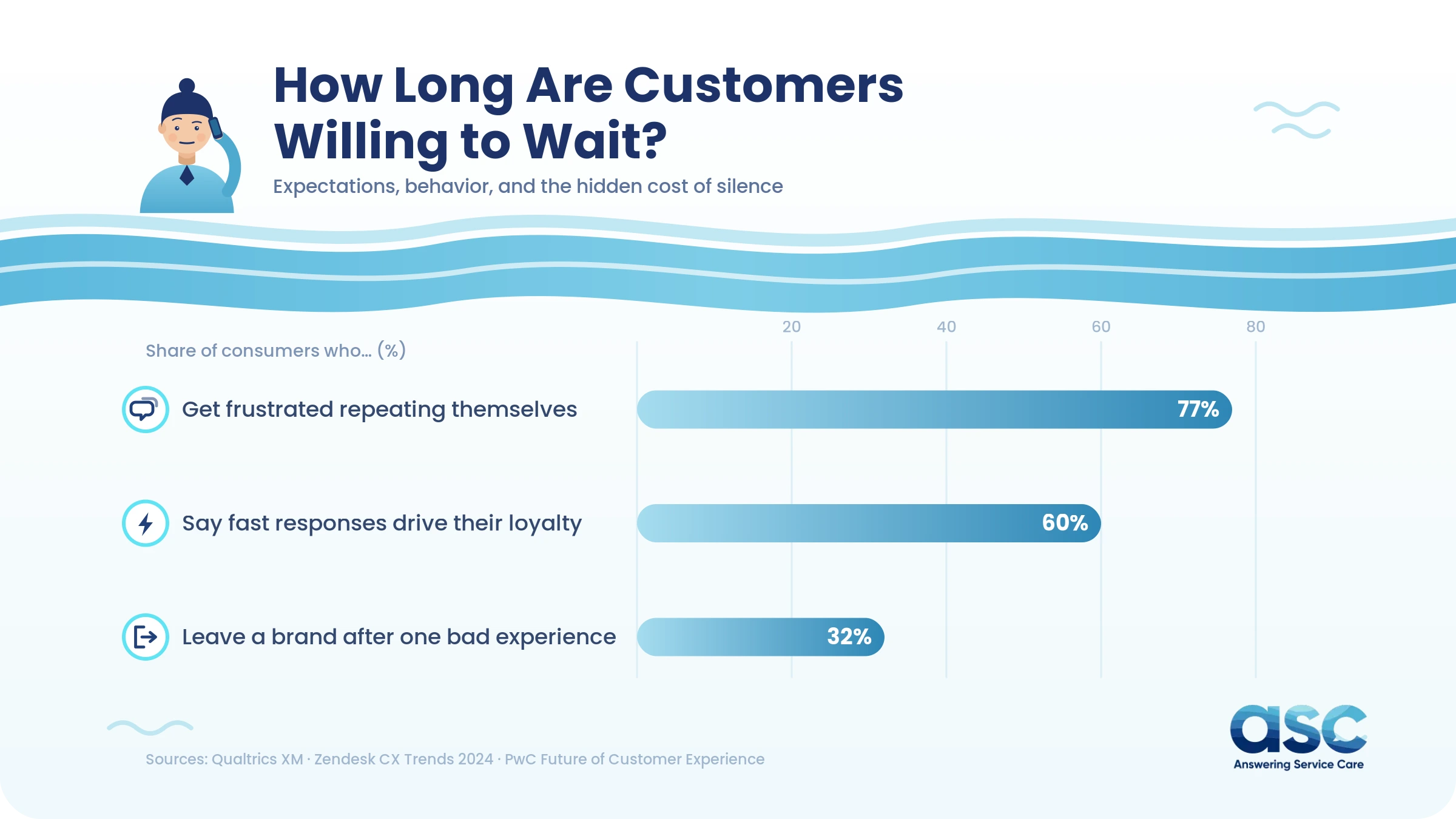
In the past, reducing wait times was mainly a matter of staffing and scheduling. Today, the tools have become more sophisticated, but so have the expectations. Modern customers want more than speed. They want acknowledgment, clarity, and convenience. According to PwC’s Future of Customer Experience report, 32% of customers will leave a brand they love after just one bad experience. The stakes are high, and the perception of time is a major player in that equation.
This article explores how companies can strategically reshape the waiting experience. Drawing on behavioral psychology, customer journey research, and the latest tools in CX design, we’ll explore how businesses can use wait time to build, not break, customer relationships. The goal isn’t just to make waits shorter; it’s to make them more thoughtful, empathetic, and aligned with brand values.
The 80/20 Rule
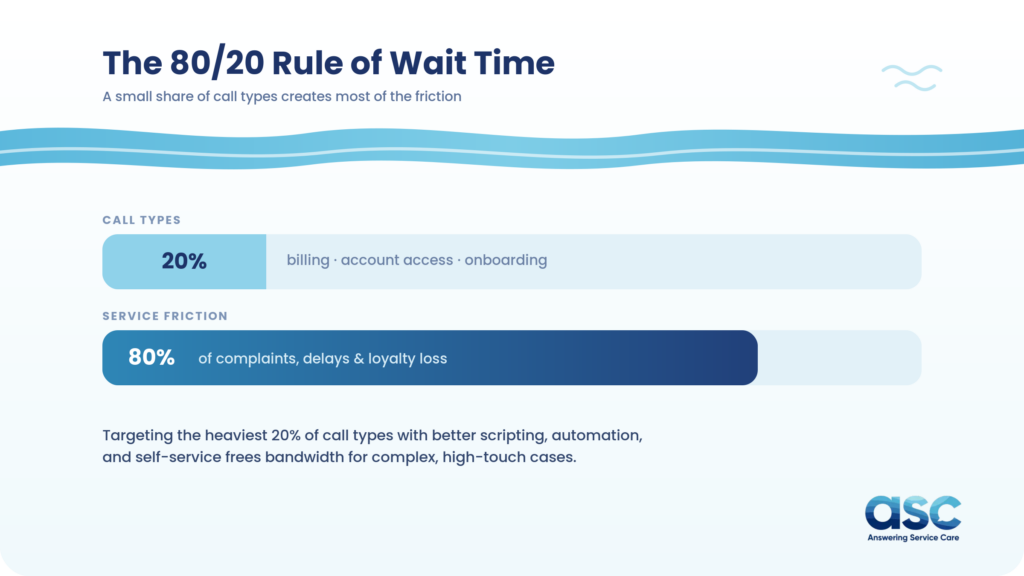
The Pareto Principle (or the 80/20 rule) is a powerful business concept that applies clearly to customer service. It tells us that a small percentage of causes (about 20%) often drives a large portion of results (around 80%). When mapped onto wait time, this principle suggests that just a few customer interactions are likely responsible for most service complaints, delays, or loyalty losses. These are the pressure points worth optimizing first.
Take, for example, billing issues, account access problems, or new customer onboarding. These calls not only make up a significant chunk of volume in many service centers, but they also carry higher emotional stakes. According to the Zendesk CX Trends 2024 Report, 60% of consumers say fast response times directly influence their brand loyalty, especially when they’re in moments of frustration or urgency. Targeting these call types with better scripting, automation, or self-service tools can reduce overall volume and create more bandwidth for complex or high-touch cases.
It’s not about trimming seconds off every interaction. It should lead to making smart decisions about where delays are most damaging. This insight is beneficial for teams facing tight resources or surging call volumes. Businesses can locate the moments that matter most by leveraging analytics tools that track wait times, first-call resolution rates, and customer feedback trends. Improvements in those areas tend to yield far more impact than a blanket approach.
Ultimately, applying the 80/20 rule to wait time shouldn’t focus solely on operational efficiency. Intentional service design is also essential. It tells your customers, “We know what you care about, and we’ve invested in getting it right.” That message goes a long way toward building trust.
The Psychology of Waiting
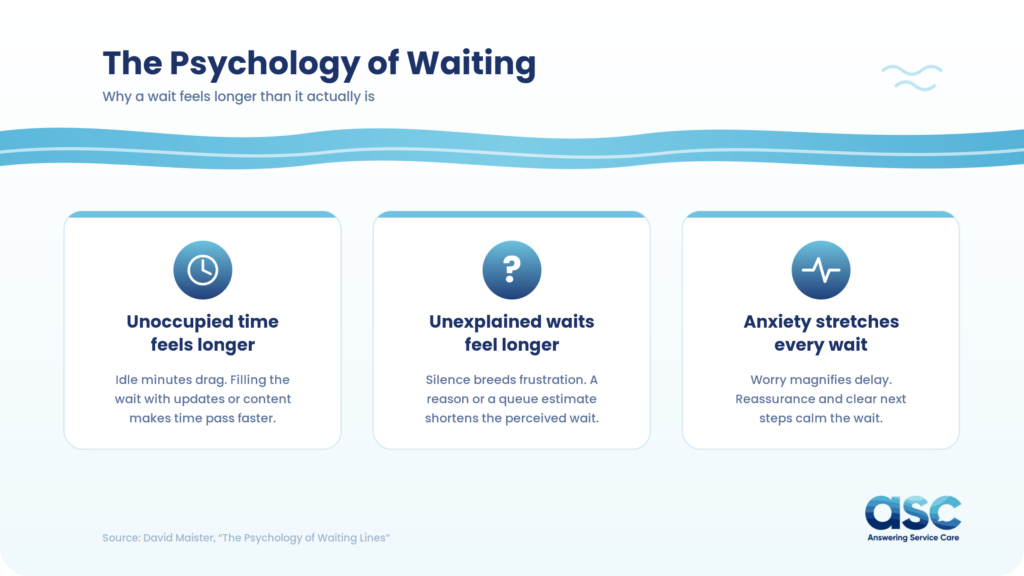
Waiting is not a neutral experience. It’s emotional, subjective, and deeply influenced by context. David Maister’s now-classic framework, “The Psychology of Waiting Lines,” identified key truths that still resonate today: unoccupied time feels longer than occupied time; unexplained waits feel longer than explained ones; and anxiety makes all waits feel worse. These psychological responses affect not just satisfaction but also the long-term perception of a company.
McKinsey’s research into time perception echoes this insight. Customers are more forgiving of delays when they feel their time is acknowledged and used productively. Silence during a wait amplifies frustration, especially without updates or explanations. In contrast, even minor engagement (like a queue update, helpful content, or a personalized message) makes time feel shorter and more tolerable.
What’s often overlooked is that the perceived fairness of a wait also matters. If a customer feels they were passed over or their wait was disproportionately long for a routine issue, the emotional fallout can outweigh the delay. That’s where proactive communication and transparency come in. Real-time wait estimates, queue position trackers, and messages contextualizing delays (“We’re reviewing your account now to save you time later”) can dramatically shift perception.
Businesses that fail to understand the psychology of waiting tend to overfocus on speed without designing for perception. Those who lean into this nuance—creating reassuring, predictable, and purposeful waiting moments—see stronger satisfaction ratings and fewer service escalations.
Emotional Cost Indexing
Traditional call queues operate on a first-come, first-served basis. But what if that model doesn’t reflect what customers need? Some calls carry more emotional weight than others, and waiting, under those circumstances, can do more harm than the clock suggests.
This is where emotional cost indexing becomes invaluable. Using cues like account history, language tone, or call reason codes, AI-powered platforms can now evaluate the potential emotional urgency of a call. For instance, automatic routing enables systems to move emotionally charged interactions, such as complaint resolutions, urgent rescheduling, or bereavement calls, further up the queue.
This method protects vulnerable customers and empowers staff. Agents can receive a heads-up about a call’s emotional nature, giving them time to prepare mentally or access relevant information. That preparation leads to calmer, more empathetic conversations and better outcomes.
Emotional cost indexing may seem like a luxury now, but it’s quickly becoming a standard for experience-driven businesses. It reflects a shift from “faster for everyone” to “better for those who need it most.” Doing so reinforces the values of care, awareness, and human understanding.
Cognitive Load
Some waits feel heavier than others, not because of their duration, but because of the mental strain leading up to them. Cognitive Load Theory, long used in education and behavioral design, teaches us that people only have so much mental bandwidth at any given time. When customers reach out to a business, they’re often doing so under stress, whether it’s due to technical problems, financial concerns, or complicated service processes.
The higher the cognitive load, the lower a customer’s tolerance for ambiguity or delay. A Qualtrics XM study found that 77% of consumers become frustrated when they have to repeat themselves, an experience that often follows a mentally exhausting wait. Worse still, even short delays feel interminable once frustration sets in. The key isn’t just shortening the wait. It’s lightening the load.
Businesses can lower cognitive burden in several ways: by providing context in queue messages (“We’re loading your billing history to make this faster”), offering simple pre-call forms that clarify intent, or deploying smart IVRs that route calls based on specific emotional or cognitive needs. These micro-adjustments make customers feel understood before they speak to a person, and they help agents prepare better responses faster.
In high-stakes industries like healthcare, law, or finance, reducing cognitive strain is an ethical imperative as much as a business strategy. Customers don’t just want fast service. They want clarity, confirmation, and confidence that they’re being taken seriously. When companies address the emotional and mental weight of the interaction, not just the wait, they unlock stronger, longer-lasting relationships.
The Often-Ignored Impact on Staff
While customer wait times dominate most conversations about CX, one audience often gets left out: the employees who field the calls. Agents who spend hours handling backed-up queues and frustrated customers face emotional wear and burnout, especially when they feel powerless to change the situation.
According to a Gartner report, unmanaged spikes in contact volume correlate strongly with staff attrition. Repeated exposure to customer frustration, paired with limited tools or resolution authority, creates stress conditions that ripple through the entire team. Even the best-trained agents will struggle if the queue never ends and each call begins with an apology.
By reducing queue pressure with more intelligent routing, AI support tools, and balanced scheduling, businesses do more than improve CX—they protect their workforce. Forward-thinking companies also train agents on technical processes, emotional intelligence, and post-wait tone recovery, allowing them to navigate strained conversations better and retain control of the interaction.
Ultimately, long waits hurt more than service scores. They wear down the humans behind the system. That’s why sustainable queue management is as much about internal culture as external reputation.
Post-Wait Recovery
Even the most carefully managed queues will sometimes result in delays. What matters most in those moments isn’t how long the customer waited. It’s what happens once someone answers. A well-crafted post-wait recovery script can defuse frustration, reset the tone, and turn a rocky start into a redemptive moment.
It starts with acknowledging the wait, but not defensively. “Thanks for your patience. While you were waiting, I looked at your account so we could jump right in.” This is simple, honest, and effective. It shows the delay wasn’t wasted. According to PwC, acknowledgment and personalization are among the top drivers of customer satisfaction, even more than resolution speed.
Agents should also be empowered to make small but meaningful gestures post-wait. This approach could mean waiving a fee, offering a proactive follow-up, or simply spending more time listening. These actions don’t just resolve issues—they rebuild trust. And when customers feel like their time and emotions are seen, they often walk away with more loyalty than if there had been no wait.
Post-wait recovery isn’t an afterthought. It’s a final mile moment that, when handled well, can transform delays into brand strength. Businesses that teach this skill set see better scores and deeper relationships.
Don’t Just Reduce Wait Times, Rethink Them
For years, businesses have chased shorter wait times as if there were a magic number that guaranteed satisfaction. But the truth is more complex and more human. What people remember isn’t always how long they waited. It’s how the experience made them feel.
A business that values time as more than a metric will build systems that acknowledge context, care, and communication. It will prioritize high-impact interactions using the 80/20 rule, equip agents to handle emotionally sensitive moments, and give customers control with tools like virtual queues and intelligent routing. It will help us understand that cognitive overload matters, that every delay carries a different emotional cost, and that what’s said after the wait matters as much as what happened before.
When thoughtfully managed, wait times become more than moments of delay. They become proof points of empathy, precision, and brand promise. Businesses that embrace this mindset don’t just win loyalty—they earn it.