
QUIZ TIME
What Does Your Hold Music Say About Your Brand?
Take our quick quiz to find out how your hold music shapes customer emotions.

Americans lose an estimated $83 billion each year to the sound of hold music. What was meant to fill a brief silence has become one of the nation’s most expensive interruptions, turning customer service delays into a measurable drain on time and patience.
Every phone call that ends up on hold tells a story about how modern life balances patience, technology, and expectation. For millions of Americans, that moment of waiting has stretched into something much larger.
Our new national survey results show that the average person spends 41 minutes on hold each month, totaling 26 full days over a lifetime. When multiplied across the country, that equals 2.8 billion hours every year, or roughly 315,000 years spent listening to hold music.
Some regions wait far longer than others. North Dakota ranks first at 128 minutes per month, while several other states approach or exceed the one-hour mark. With so much collective time spent listening, what callers hear during those minutes influences how they feel about the businesses on the other end.
The data paints a detailed picture of how Americans experience time on hold. It reveals where the minutes go, how music influences emotion, and how each sound choice shapes the impression of a brand. Beneath those patterns lies another story about legality and trust, as many companies use unlicensed tracks without realizing the risk.
The findings reveal a simple truth: what plays between rings can define how customers remember a business.
Take our quick quiz to find out how your hold music shapes customer emotions.
Every minute on hold carries a hidden price. Across the United States, those small delays add up to more than 2.8 billion hours each year. When measured against the national average wage, that time represents an estimated $83 billion in lost productivity.
For the average caller, that means 41 minutes on hold every month, equal to nearly a full workweek each year spent waiting to speak with someone. Multiply that by millions of households, and the impact becomes impossible to ignore.
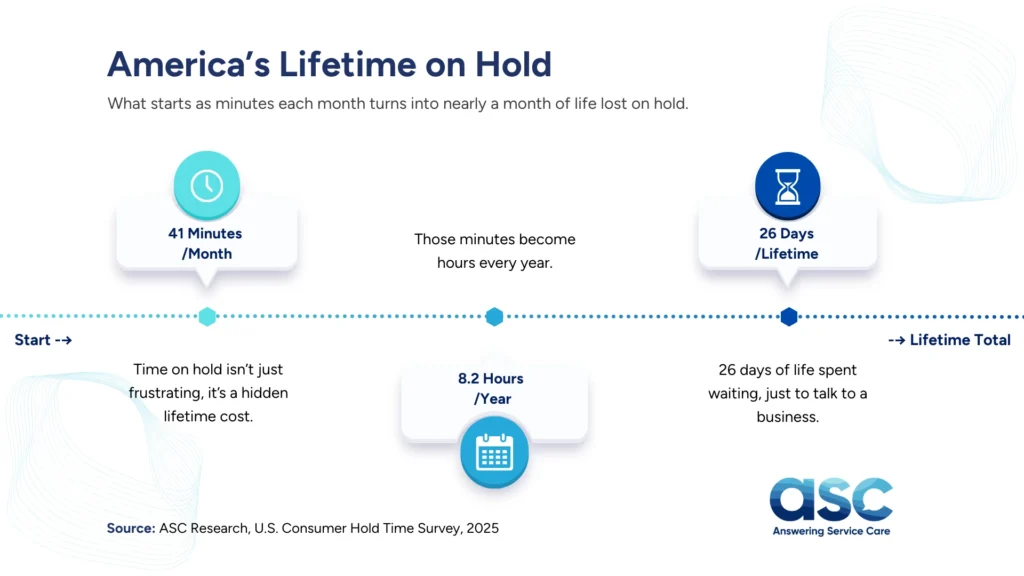
The numbers vary sharply by location. North Dakota ranks highest, with residents reporting an average of 128 minutes per month on hold. Idaho and Washington follow closely at 73 minutes, while Delaware and California round out the top five at 63 and 58 minutes, respectively. These differences reflect both regional service volume and infrastructure gaps, showing how uneven the nation’s customer experience landscape has become.
Visualizing those minutes tells a clear story: a single caller’s monthly wait may feel minor, but the national hold clock continues to tick without pause. Over a lifetime, those moments equal 26 days spent listening to hold music, nearly a month devoted entirely to waiting.
Each second represents lost time, missed opportunity, and declining satisfaction. Businesses that shorten hold duration protect productivity and preserve the trust that callers lose when the silence stretches too long. At Answering Service Care, we help businesses achieve that by connecting callers with live support before the wait becomes a barrier.
Most callers recognize the sound instantly: a pop hit playing softly while they wait for a representative to answer. According to our survey data, 80% of Americans say they’ve heard familiar chart music while on hold. This finding raises a key question about compliance, since popular tracks often require expensive commercial-use licenses that many businesses may not realize are necessary.
Playing copyrighted music in a business setting is not as simple as queuing a playlist. Well-known artists such as Taylor Swift, Drake, and Beyoncé are protected under performance rights that limit the use of their songs. To legally include those tracks in an on-hold system, a business must obtain proper licensing through performance rights organizations such as ASCAP, BMI, or SESAC. Under U.S. copyright law, broadcasting a song through a business phone system constitutes a public performance, which typically requires a license.
The performance rights industry is enormous in scale. Unlicensed or not, hold music represents a hidden corner of a business worth billions. Together, performance-rights organizations collect millions in royalties every year for the use of protected works.
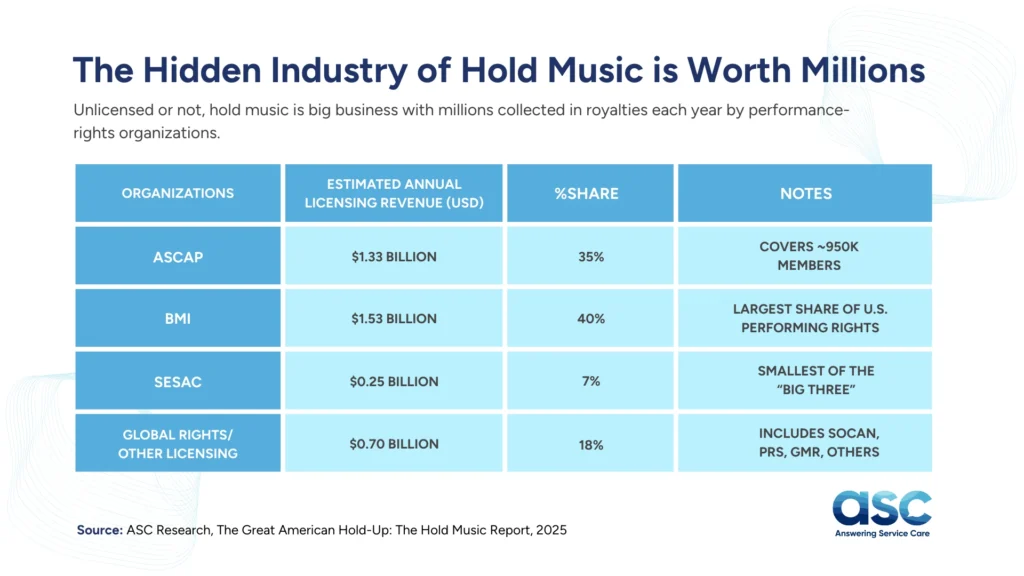
Without them, companies risk crossing into the territory of copyright infringement, even unintentionally.
The misconception often stems from streaming platforms. Services like Spotify, Apple Music, and YouTube only grant personal-use rights. The moment a track is transmitted to callers through a business phone line, it qualifies as commercial use and is treated differently under copyright law. Some organizations remain unaware of that difference, assuming a paid subscription covers business use.
The financial and reputational consequences of copyright violations can be serious. Legal actions over unlicensed music have resulted in significant fines and negative publicity. Even the perception of misuse can damage customer trust, suggesting a lack of professionalism or attention to detail.
Choosing properly licensed or royalty-free music eliminates that risk. It also gives businesses more control over their brand identity, allowing them to design a consistent caller experience that aligns with their image. Some companies even use custom-composed tracks or neutral ambient sounds to project calm professionalism while staying compliant.
What plays while someone waits is more than background noise. It reflects how seriously a company approaches compliance, communication, and the trust that binds them together.
Hold music does more than fill silence. The right track can ease frustration, while the wrong one can amplify it. According to our survey, 63% of Americans say hold music influences how they perceive a brand. That number climbs to 76% among people aged 35 to 44, a group that reports the strongest emotional reaction to the music playing while they wait.
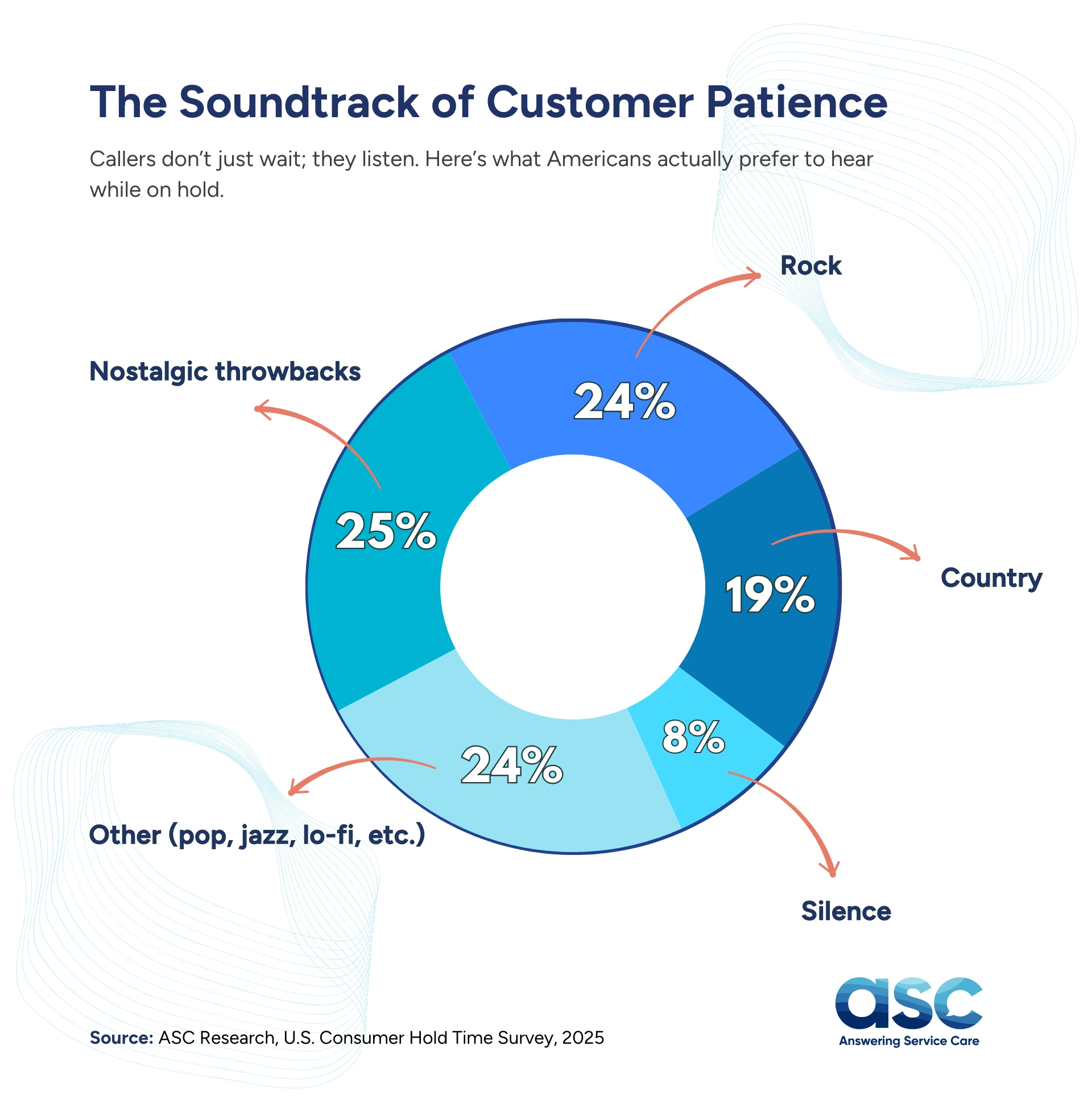
Music style also matters. 25% of respondents prefer nostalgic throwbacks, 24% want rock, 19% favor country, and 8% would rather hear silence than music at all. Nearly one in four believe that the music a company chooses directly defines its identity, illustrating the close connection between sound and reputation. Even among those aged 55 and older, half admit that hold music still shapes their view of a business.
A small but notable 5% say they have formed a negative opinion of a company purely because of its hold music. That sentiment highlights how background sound can unintentionally influence customer loyalty long after the call has ended.
When asked which artists made them feel calmest while waiting, respondents ranked Elton John at the top with 60%, followed closely by The Beatles (59%), Queen (49%), Ed Sheeran (47%), and Coldplay (41%).
The artists most likely to frustrate callers were led by Taylor Swift (11%), followed by Beyoncé (10%), Snoop Dogg (10%), Lizzo (9.5%), and Drake (9%).
These results reveal how hold music functions as emotional branding. A calm melody can reinforce reliability, while an energetic chart hit can divide opinion. For businesses, a sound choice is an integral part of their brand strategy. The right approach can foster calmness and establish credibility before a single word is spoken.
Every hold tone and waiting melody represents more than a pause in conversation. Together, those moments now account for 315,000 years of collective listening time annually in the United States. This figure reflects both an economic and emotional burden. The cost to productivity is significant, yet the effect on perception may be even greater.
Across every data point in our survey, one pattern stands out: what people hear while they wait directly shapes how they judge the business behind the line. Calming music encourages patience and confidence, while repetitive or distracting tracks make the wait feel longer. These small differences in sound influence how customers remember an interaction long after the call ends.
Beyond perception, the research raises broader questions about compliance. Many companies may not realize that playing copyrighted music on hold often requires commercial licensing. Without it, they could face unnecessary legal and reputational risks. The potential for non-compliance underscores the need for clearer standards and greater awareness around how hold music is selected and managed.
Hold music has become an often-overlooked yet powerful component of customer communication. It can either reinforce trust or undermine it. Businesses that treat those waiting moments with care turn an unavoidable delay into an opportunity to show respect, reliability, and control.
Findings in this report are based on a nationwide survey of 2,000 U.S. consumers conducted in 2025. Respondents were asked about time spent on hold, their emotional reactions to hold music, and how those experiences influence their perception of brands.
Economic estimates were calculated using the average U.S. hourly wage of $30, combined with national population data from the U.S. Census Bureau and the Centers for Disease Control and Prevention (CDC). This approach was used to estimate the total hours and financial cost of time spent on hold each year.
While our survey focused on consumer sentiment, it also provides context for understanding the broader operational and compliance challenges faced by businesses that manage customer phone systems.
Adding {{itemName}} to cart
Added {{itemName}} to cart