
AI is becoming an increasingly significant part of how businesses manage customer calls, and callers are taking notice. What they are not getting is clarity. Many people already assume AI is involved in support conversations, yet they often do not know when or how it is used. That uncertainty creates tension, affecting how long callers stay on the line. Findings from our Robots Reveal Yourself: The AI Call Report show that nearly 80% of Americans believe companies should identify AI at the start of a call, and most say they now encounter AI several times a day.
For businesses that rely on answering services, this shift carries real consequences. Phone support succeeds when callers feel understood and informed, and that depends on knowing who or what is helping them. When the experience feels uncertain or hidden, trust weakens, and callers disengage before your message ever reaches your team. AI will continue to play a role in phone support, but the real question is how to introduce it in a way that keeps your customers comfortable and maintains consistent communication.
So what does responsible AI disclosure look like in voice support? And how can answering services use transparency to strengthen caller confidence as expectations change?
Why Phone Support Needs Early, Clear AI Call Disclosure
Phone conversations rely on clarity in a way text-based channels do not. When callers cannot see who they are speaking to, everything depends on the first few seconds. That is why AI disclosure matters more in voice support than almost any other interaction. Callers form their impression immediately, and if something feels unclear or unexpected, confidence fades fast.
Our research reveals the sensitivity of this moment. Nearly 40% of Americans say they lose trust when AI is used without disclosure. That reaction happens long before the content of the call matters. It is triggered by uncertainty, not by the quality of the technology.
At the same time, more than six in ten small business owners worry that a lack of transparency could lead customers to hang up and take their business elsewhere. Both groups are responding to the same thing: surprise.
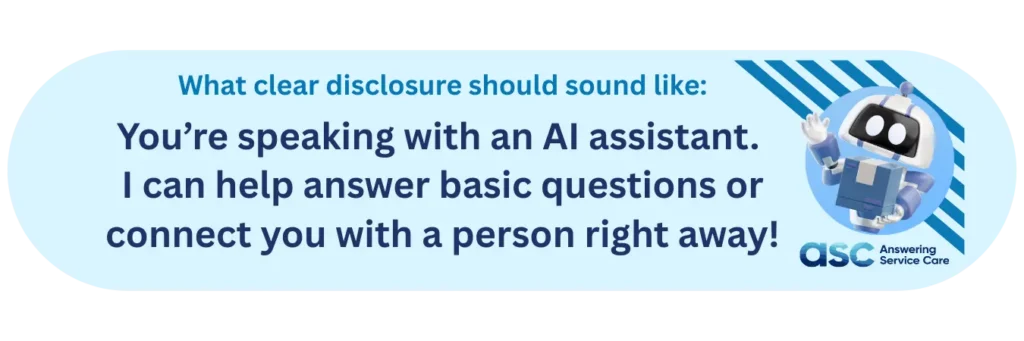
A simple, upfront introduction prevents that reaction. A warm, brief line such as, “Hi, I am an AI assistant here to help and can connect you to a representative anytime,” gives callers the clarity they need to stay engaged. It removes the guesswork, reduces hesitation, and signals that the company values honesty. It also prevents callers from discovering AI halfway through the conversation, which is when frustration spikes and the risk of abandonment increases.
Early disclosure does not slow the conversation. It protects it. And in phone support, protecting the call means protecting the customer relationship.
How Businesses Can Disclose AI Without Losing Callers
Some business owners worry that disclosure may cause callers to disconnect quickly. Our research shows why that fear exists. More than half of callers react negatively when they discover, mid-call, that they are speaking with an AI, and nearly one-third hang up immediately. The issue is not disclosure itself. It is the timing and tone.
When disclosure happens too late, it feels misleading. When it happens at the start, it feels honest. This distinction is central to reducing churn.
Effective disclosure begins with purpose, not with technology. Callers want to know why the AI is there, what it can do, and what options they have. A transparent introduction, such as “I can help answer basic questions or connect you with a person right away,” positions the AI as a helper rather than a barrier.
This approach gives callers control. It lowers frustration and increases their willingness to stay on the line. It also reinforces trust in the company. More than 40% of consumers say they are more likely to trust businesses that are upfront about how their systems work.
Disclosure is not a risk when done correctly. It is a stabilizer that helps callers stay engaged long enough to get what they need.
Techniques Answering Services Can Use to Maintain Trust After AI Disclosure
The moment after disclosure is made is just as important as the disclosure itself. Callers who know they are speaking with AI behave differently, and trust must be reinforced quickly.
Role framing is an effective technique. Callers respond better when the AI clearly explains what it can handle. A statement like, “I can help update account information or route you to a representative,” establishes boundaries that prevent confusion.
Predictable routing is equally important. Our research indicates that callers are more likely to trust companies when interactions proceed as expected. If a caller says “representative,” the system should route the call immediately. Delays and forced loops erode trust more quickly than any other aspect of the experience.
For small businesses, these steps are even more crucial. 62% of SME owners fear financial losses from abandoned calls, which means every preserved interaction is a measurable win. After disclosure, AI should never force callers to repeat themselves or guess at next steps. Clean design is essential.
Maintaining trust after disclosure is not about making AI more human. It is about respecting the caller’s time and giving them control.
AI Call Disclosure in Phone Support Outlook
AI call disclosure laws are evolving, and answering services should prepare for changes in caller expectations and regulatory standards. Several states, including California, Colorado, Utah, Texas, and Tennessee, have already introduced legislation related to AI transparency or voice authenticity. While these laws vary widely in scope, they share a common theme. Consumers deserve clarity about who or what they are speaking with.
The Keep Call Centers in America Act also reflects this direction. Although the bill is still being developed, one of its primary objectives is to enhance transparency requirements for offshore and AI-driven support functions. As these measures progress, answering services nationwide will need to adapt.
Preparing for the future means designing phone support systems that work across multiple regulatory environments. Processes that prioritize disclosure, caller control, and quick transitions to human support will remain stable as new rules emerge.
Callers are already signaling what they expect. Nearly 80% believe AI call disclosure should be required by law, and many assume AI is being used even when it is not. That expectation alone shapes the future of voice support.
Businesses that adapt early will earn trust before regulations require it. They will reduce risk, improve caller experience, and differentiate themselves in a competitive market.
The Future of Phone Support Depends on Trust
AI is reshaping how many answering services operate, but transparency will decide whether that shift strengthens or weakens the caller experience. People want to know who they are speaking with and how their questions are being handled. When that clarity is missing, frustration grows, and callers often leave the conversation before your business has a chance to hear from them.
For companies that rely on phone support, transparency offers a clear advantage. When callers understand from the beginning whether they are speaking with AI or a live agent, conversations are smoother, fewer calls are lost, and more opportunities reach your business with trust already in place. It also positions you ahead of emerging state regulations, which increasingly value honesty in customer communication.
At Answering Service Care, we believe the most reliable way to protect that trust is through a real human connection. AI may assist certain tasks behind the scenes, but it cannot replace the empathy, warmth, and judgment that trained agents bring to every conversation. Our focus remains on people solving problems for people, because that is what keeps callers calm, engaged, and willing to stay on the line.
Trust is built one interaction at a time. When your answering service prioritizes clarity and human connection, your customers feel respected, your calls are more successful, and your business is better prepared for the future of phone support.