
Robots Reveal Yourself: The AI Call Report


Artificial intelligence is no longer confined to science fiction or research labs. It is already answering phones, handling customer support, and shaping conversations with millions of Americans every day, with or without your knowledge.
That silence is not harmless, though. It erodes trust, puts small businesses in jeopardy, and leaves lawmakers scrambling to catch up.
The numbers collected in our survey of 2,000 American consumers illustrate the scale of the problem. Nearly eight in 10 Americans say AI should identify itself at the start of a customer service call. Trust fractures without it: 37% of consumers say they would lose confidence in a company that hides AI, while 40% are more likely to trust those that are open about its usage.
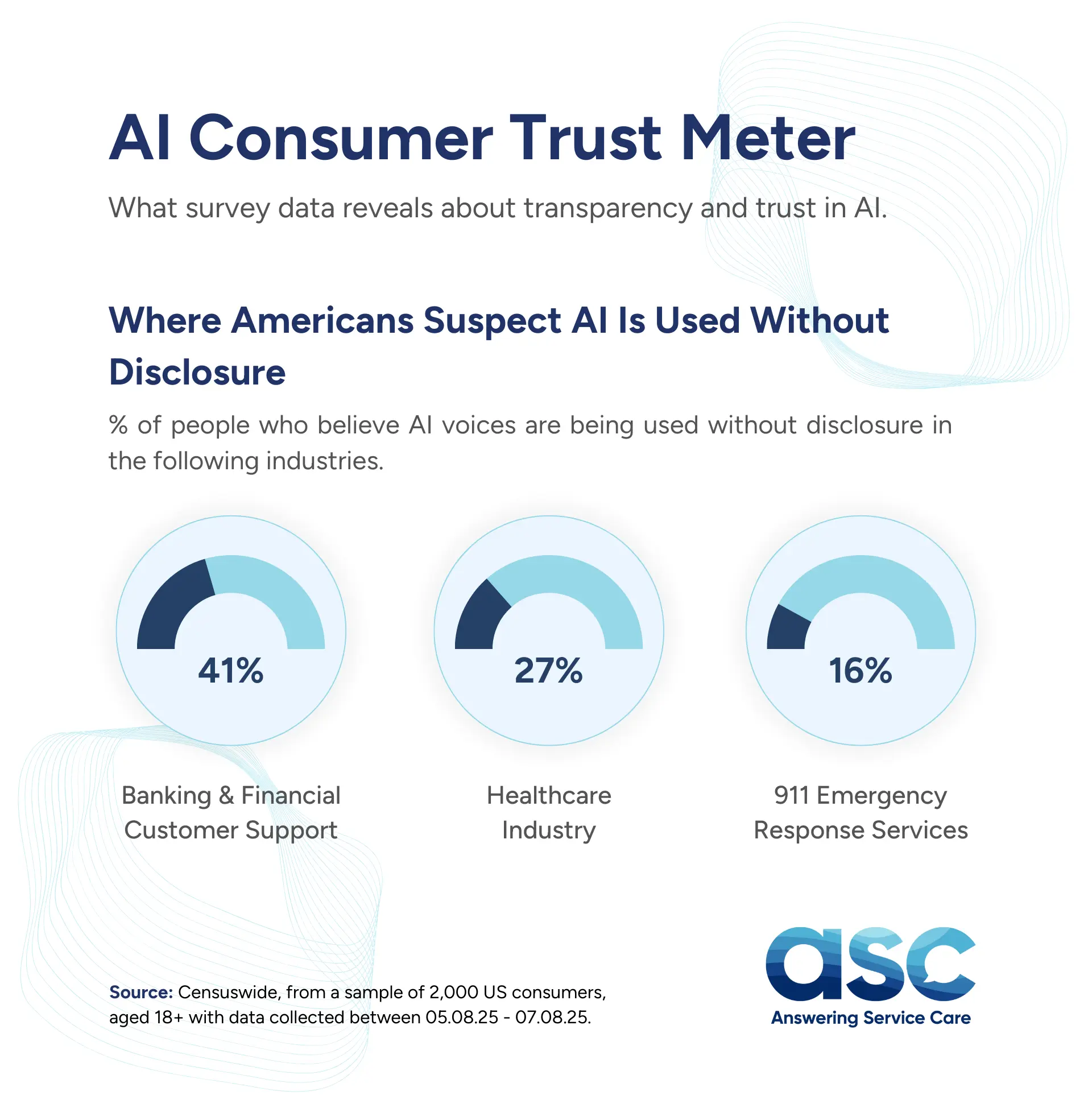
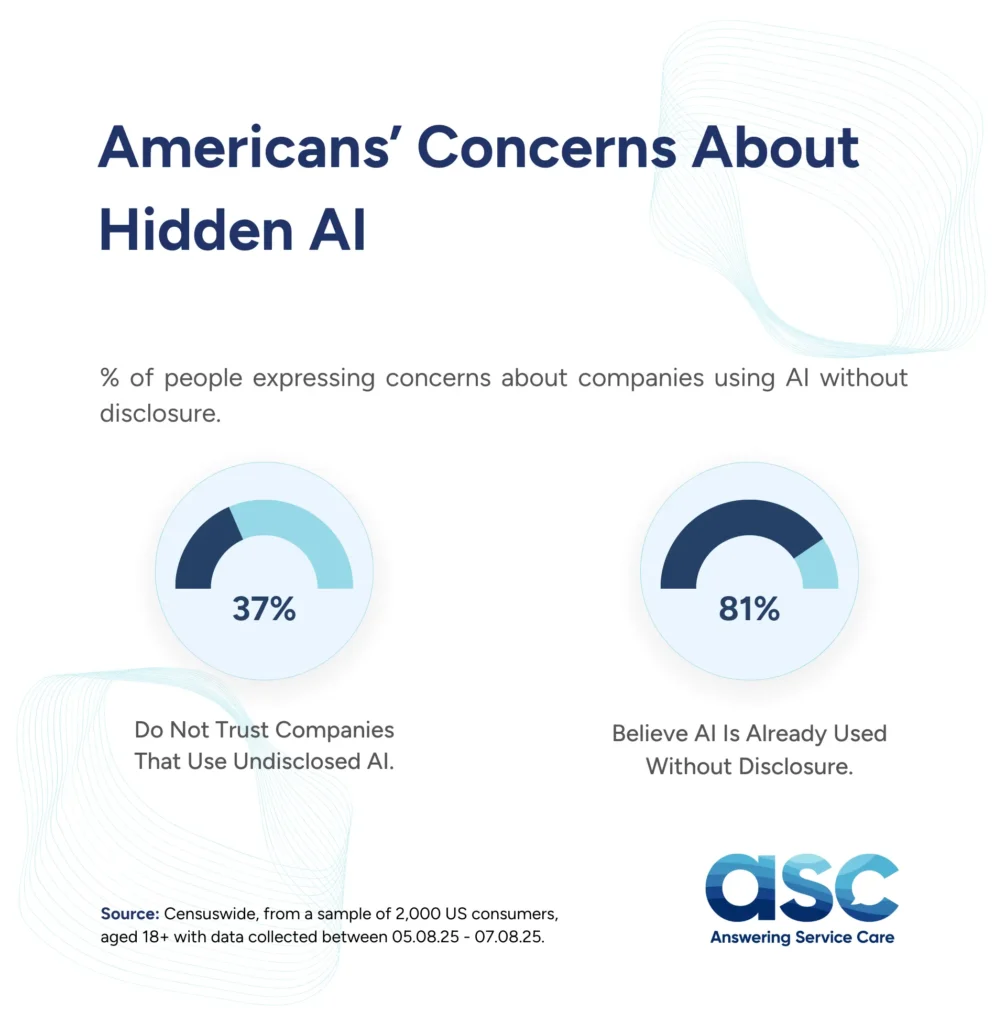
Suspicion is widespread, with 81% convinced AI is being used secretly and six out of 10 worried it is shaping sensitive interactions in banking, healthcare, and even emergency services.
We surveyed 250 small businesses to get their views, and they see the same danger but from a different angle. 62% of SME owners fear financial losses if customers abandon calls once AI is revealed, and 43% worry about long-term damage to trust. Efficiency may be appealing, but secrecy makes it unsustainable.
Answering Service Care is advocating for mandatory AI disclosure laws across the U.S. and globally. One such opportunity is to ensure AI disclosure is included in the Keep Call Centers in America Act of 2025. The aim is simple: give consumers the right to know, restore confidence in answering services, and help small businesses avoid the financial and compliance risks associated with hidden AI, while also preserving call center jobs in the United States. By linking disclosure to job protection, the act reinforces both transparency and the broader priority of supporting American workers.
Secret AI is Everywhere, and Americans are Fed Up
Consumers increasingly suspect that AI voices are shaping their daily interactions, and the lack of disclosure is wearing away confidence.
Our survey data shows that eight in 10 Americans believe undisclosed AI is being used in customer service, and the average person estimates they now speak with an AI voice nearly three times per day. That frequency transforms what might seem like a novelty into a daily reality, and one that is not being handled transparently.
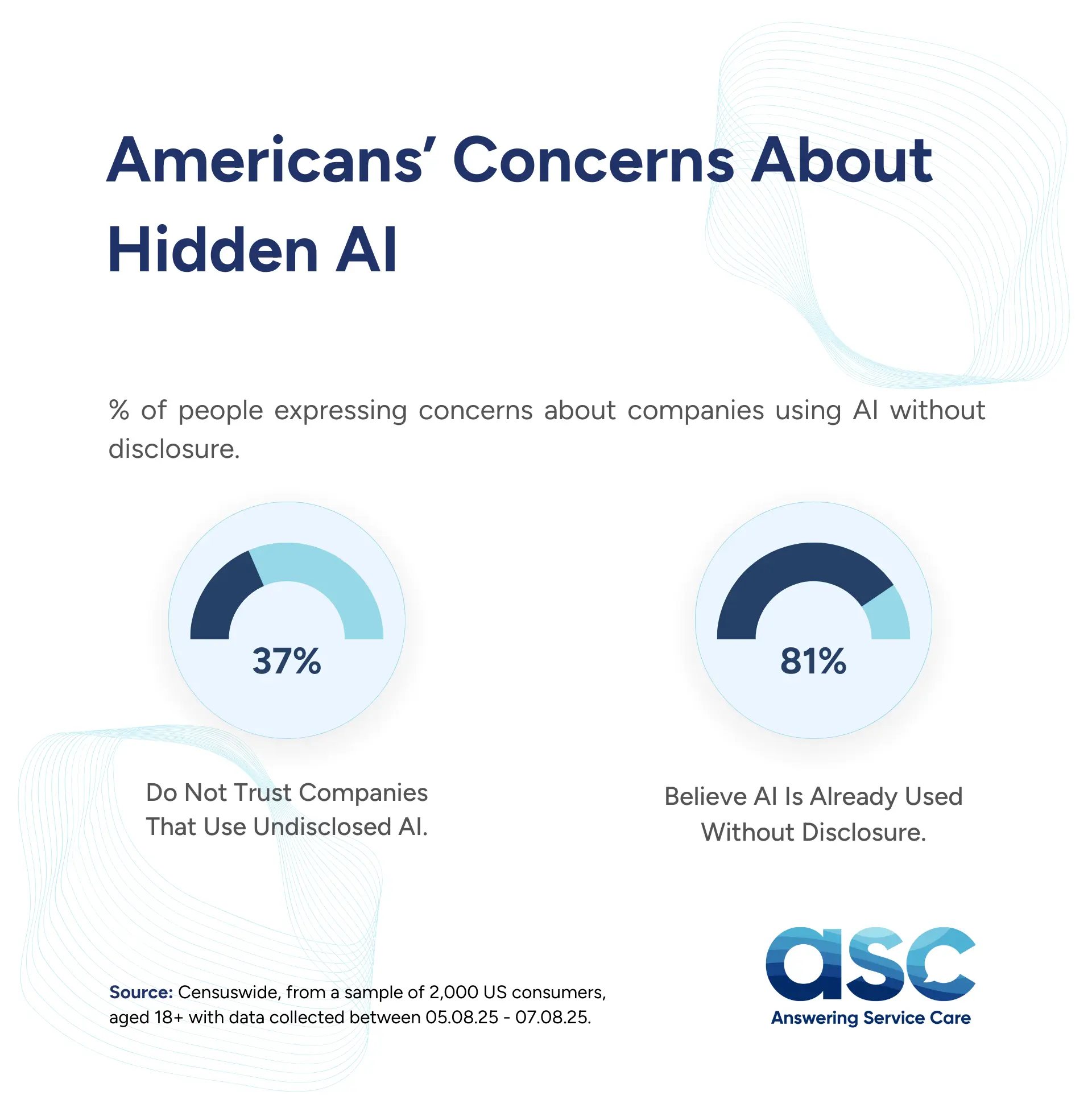
That suspicion reaches many parts of consumers’ daily lives. Overall, 71% of Americans fear AI voices are being used without disclosure, with 41% specifically worried about bank or financial support lines. Another 34% suspect that tax or government helplines are doing the same. When even financial and government institutions are seen as hiding AI, it reinforces the sense that no sector is fully transparent from the consumer perspective.
Even essential services are not immune to the concerns. More than a quarter of people (27%) believe doctors’ offices and medical advice lines are using AI voices without telling patients. That kind of concern shows how quickly trust can unravel in areas where reassurance matters most. And to highlight this point further, 16% fear the same could be happening with 911 and emergency response calls.
The public’s reaction is sharp. When companies fail to disclose AI use, 37% of people say they lose trust, one in four describe the experience as a “betrayal,” and 15% would boycott the brand entirely. This is more than frustrating for many consumers. It is a breakdown of the relationship between the customer and the company.
Even disclosure can trigger tension if it comes at the wrong time. More than half of consumers (55%) react negatively when AI identifies itself. Of those, 22% hang up immediately, while another 28% demand to be transferred to a human representative.
That means that, by secretly using AI, one in three customer interactions can be lost on the spot, while more than half risk being disrupted. This is a costly outcome that puts both loyalty and revenue at stake.
For businesses, these numbers highlight a core truth: AI secrecy is no longer a hidden risk. It is a visible threat to trust, brand reputation, and revenue. Without clear disclosure laws, customers will continue to feel deceived, and businesses will continue to face the fallout.
The Solution: Transparency Through Regulation
The simplest way to resolve consumer frustration and business risk is to make disclosure the standard, not the exception. When companies hesitate, they place the burden on customers to figure out who (or what) they are speaking with. Regulation removes that uncertainty.
Nearly eight in 10 Americans believe disclosure should be written into law, and close to half expect that acknowledgment the moment a call begins. This sentiment echoes long-standing consumer protections.
Just as recording a call requires notice with phrases like “This call may be monitored for quality assurance.,” AI use should be treated with the same level of transparency. The principle is the same. People have a right to know how their interactions are being managed.
Not only that, but the cost of ignoring this demand is steep. 22% of consumers say they would hang up if they realized mid-call that they were speaking to AI, meaning thousands of customer interactions could evaporate in an instant.
Each abandoned call carries lost revenue, eroded trust, and the possibility that the customer may never return. Clear disclosure laws set expectations upfront, reducing abandonment and preventing those losses before they happen.
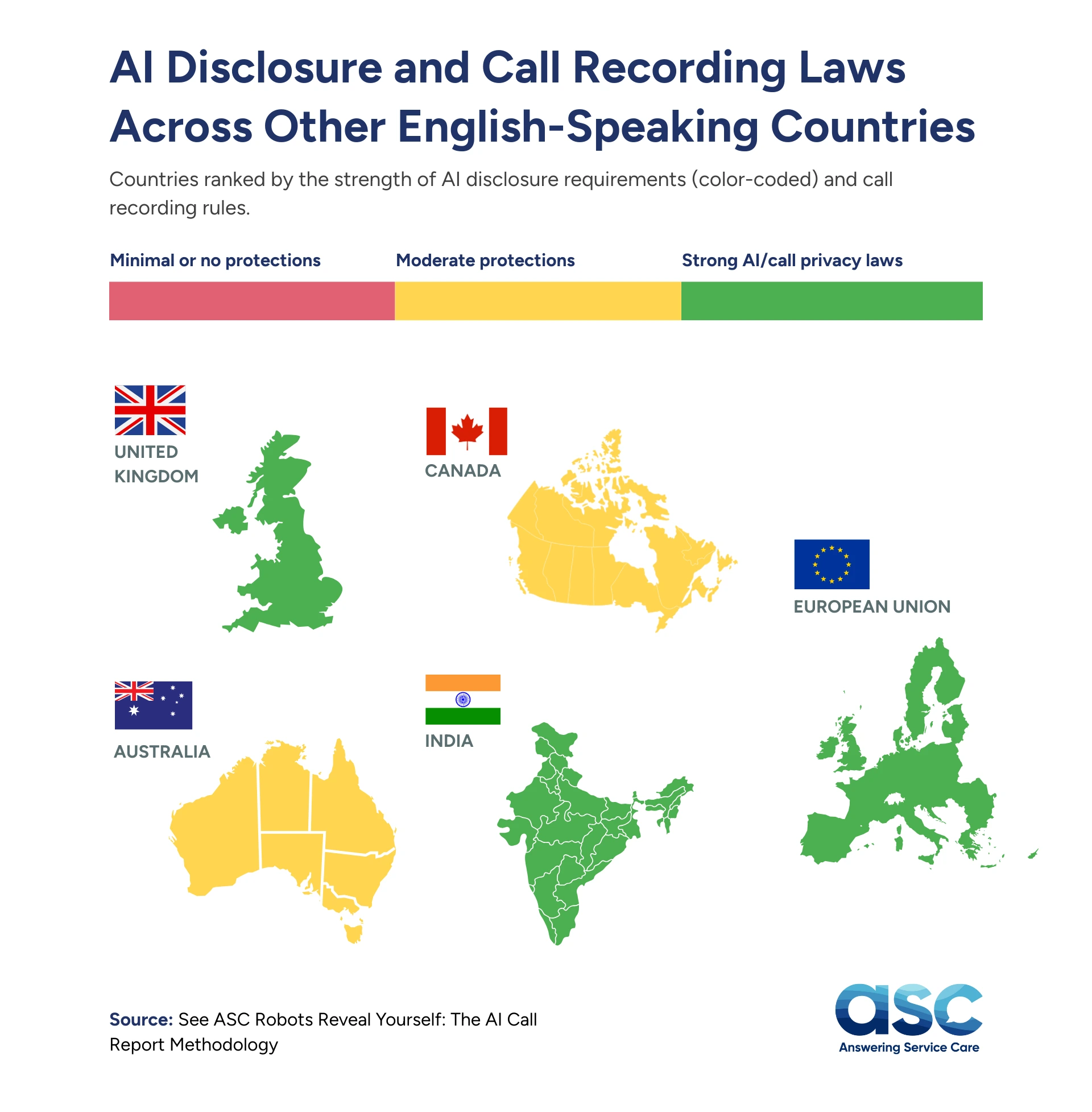
International precedent suggests where the U.S. may be heading for a solution to this problem. The European Union’s AI Act requires proactive disclosure in every AI-driven interaction. India has introduced similar requirements, while Canada’s proposed Artificial Intelligence and Data Act emphasizes transparency as a cornerstone of trust. Together, these models show how regulation can transform disclosure from an inconsistent practice into a global standard.
For businesses, this is not a threat. It is an opportunity. Rules that apply equally across industries protect companies from accusations of secrecy, build customer confidence, and level the playing field. By embracing regulation early, businesses can strengthen relationships instead of risking them.
Explore AI Disclosure, Call Recording, and Telemarketing Laws Across the U.S.
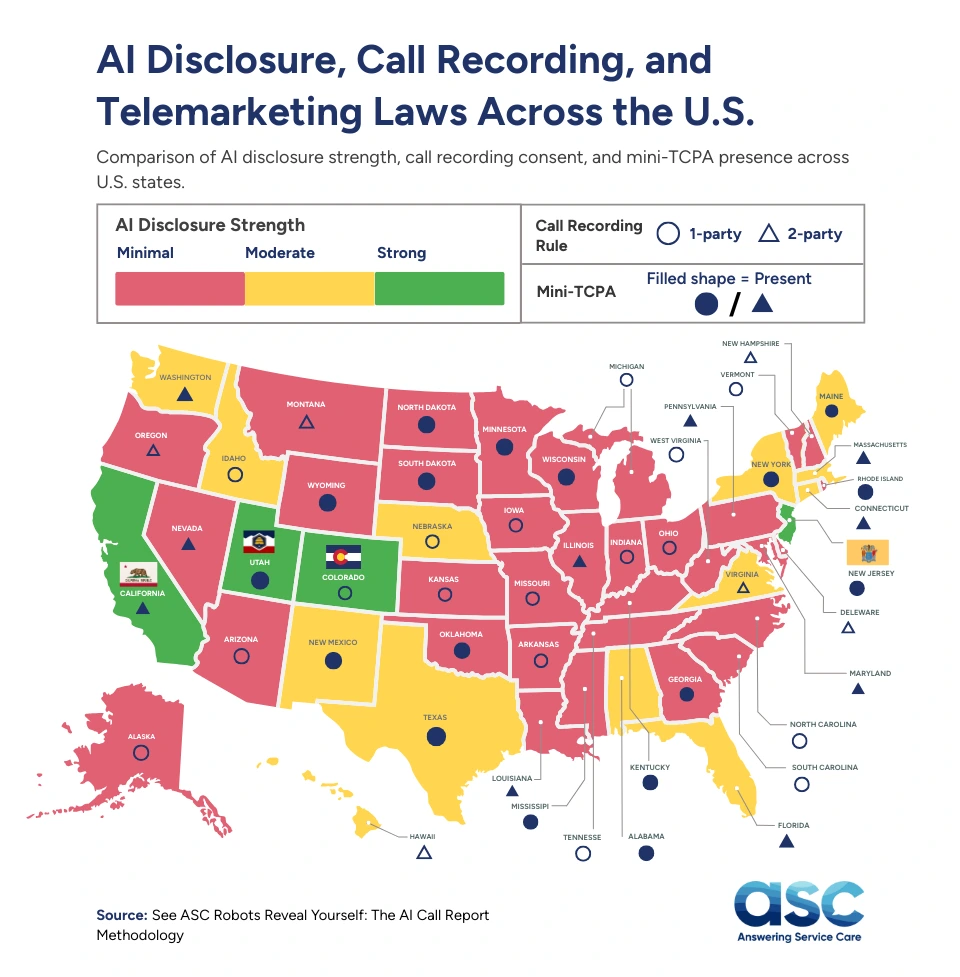
In the United States, there is no single federal law that governs AI disclosure in customer service calls. Instead, regulation is left to individual states, producing a patchwork of rules that vary dramatically across the country.
A significant difference between states’ current protection laws is dependent upon consent. In one-party states, only one person has to know a call is recorded. In two-party states, everyone must be told, and if a call crosses state lines, the stricter rule applies.
Some states have strong safeguards for consumers, while others provide almost none, leaving both businesses and callers navigating a landscape defined by uneven protections.
California stands out as one of the most aggressive regulators. Its two-party consent law requires that every participant in a call be informed if a recording is taking place, a rule that provides far more protection than the one-party consent policies common elsewhere.
In 2024, lawmakers advanced the California AI Transparency Act (SB-942), making California one of the first states to explicitly mandate AI disclosure in call interactions. This legislation carries a penalty of $5000 per violation, per day. The California Privacy Protection Agency also adopted the California Consumer Privacy Act (CCPA), sometimes referred to as a “mini-TCPA,” with fines up to $7,500 for privacy violations. Together, these measures have positioned California as a national benchmark for transparency.
The regulation is modelled after the federal Telephone Consumer Protection Act (TCPA), a set of nationwide rules for telemarketing that requires consent for autodialers and prerecorded calls, creates the Do Not Call Registry, and imposes steep fines for violations.
Other states are following different paths to AI regulation. Utah became the first state to pass a broad AI disclosure law, S.B. 149, effective May 1st, 2024, which holds businesses accountable if they fail to disclose AI in consumer interactions.
Colorado’s Consumer Protections for Artificial Intelligence Act (SB24-205) will take effect in June 2026. It targets “high-risk” AI systems, and companies must follow strict regulations for documentation, risk management, and disclosure. This is especially true in finance, law, and healthcare. Violators could face penalties of up to $20,000 per infraction.
Elsewhere, momentum is building. Texas passed the TRAIGA Act, which regulates the use of AI-generated voices in political calls and advertising. The TRIAGA Act builds on an existing framework of state telemarketing restrictions similar to the federal TCPA.
Tennessee’s ELVIS Act updated state law to protect performers’ likenesses and voices from unauthorized AI use. This complements the state’s long-standing telemarketing protections under its own consumer law.
The Illinois Automatic Telephone Dialers Act functions as a “mini-TCPA” by restricting robocalls and deceptive practices. As a follow-up to the ATDA, Illinois amended its Human Rights Act to limit the misuse of AI in employment decisions, reflecting growing concern about bias and fairness.
New Jersey already enforces its own telemarketing statute, also modeled after the TCPA. This statute requires telemarketers to register with the state, adhere to calling-hour restrictions, and comply with the Do Not Call list.
Building on that approach, lawmakers passed Assembly Bill 3540 in 2025. It criminalizes the creation or distribution of deceptive AI-generated media, commonly known as deepfakes. The statute carries penalties of up to $30,000 and potential prison time.
While none of these measures directly mandate AI disclosure in customer service calls, the combination of AI-specific statutes and telemarketing laws signals these states are moving in the right direction. By targeting transparency, authenticity, and accountability in adjacent industries, these states show how disclosure requirements for call centers may be the next logical step.
For call centers, this signals that AI transparency is becoming part of broader consumer protection, not just a customer service issue. Ethical concerns are rising, too. From potential job losses to the erosion of human empathy, it raises questions about whether AI will enhance agents or quietly replace them.
By contrast, states like Indiana, Rhode Island, and Nebraska follow one-party consent laws, where a call may be recorded if only one person is aware. Yet this looser framework applies only when both parties are in-state. If a call involves someone in a two-part state like Florida, Massachusetts, or California, the stricter law governs, and penalties follow.
This fragmented approach is not new in the United States. Call recording and telemarketing laws developed in much the same way, with state-level experimentation laying the groundwork for broader national standards. AI regulation is now following that same trajectory, where states act first and federal action lags behind.
For SMEs, the result is a compliance maze. A policy that is perfectly legal in one market could trigger fines or lawsuits in another. Lacking the legal departments of larger corporations, many small businesses are forced to adopt the strictest standards just to stay safe nationwide.
Until Congress intervenes with a federal framework, SMEs will continue bearing the cost of adaptation while consumers remain uncertain about what protections they can rely on.
For Consumers: Support AI Disclosure Laws
Download our pre-written constituent letter and send it to your local officials. See where your state stands on AI disclosure laws, and urge stronger protections for consumers against hidden AI.
For Small Businesses: Protect Against Hidden AI
Download our pre-written small business letter and send it to your local officials. Learn where your state stands on AI disclosure laws, and advocate for stronger protections to keep businesses and their customers safe from hidden AI.
Small Businesses Fear AI Risks and Promote Transparency
AI presents SMEs with both promise and peril. On one hand, automation can help small teams scale customer service. On the other hand, many owners see it as a threat to trust and revenue.
43% say they fear losing customer confidence if they adopt AI, 62% worry about financial losses from abandoned calls, and 35% believe disclosure itself could cause customers to hang up.
Regional differences across the United States sharpen this concern. In the West, more than half of owners cite trust loss as their greatest risk. In the Northeast, two-thirds focus on the financial damage of abandonment. Regardless of geography, the unease is consistent. Hidden AI feels like a gamble few are willing to take.
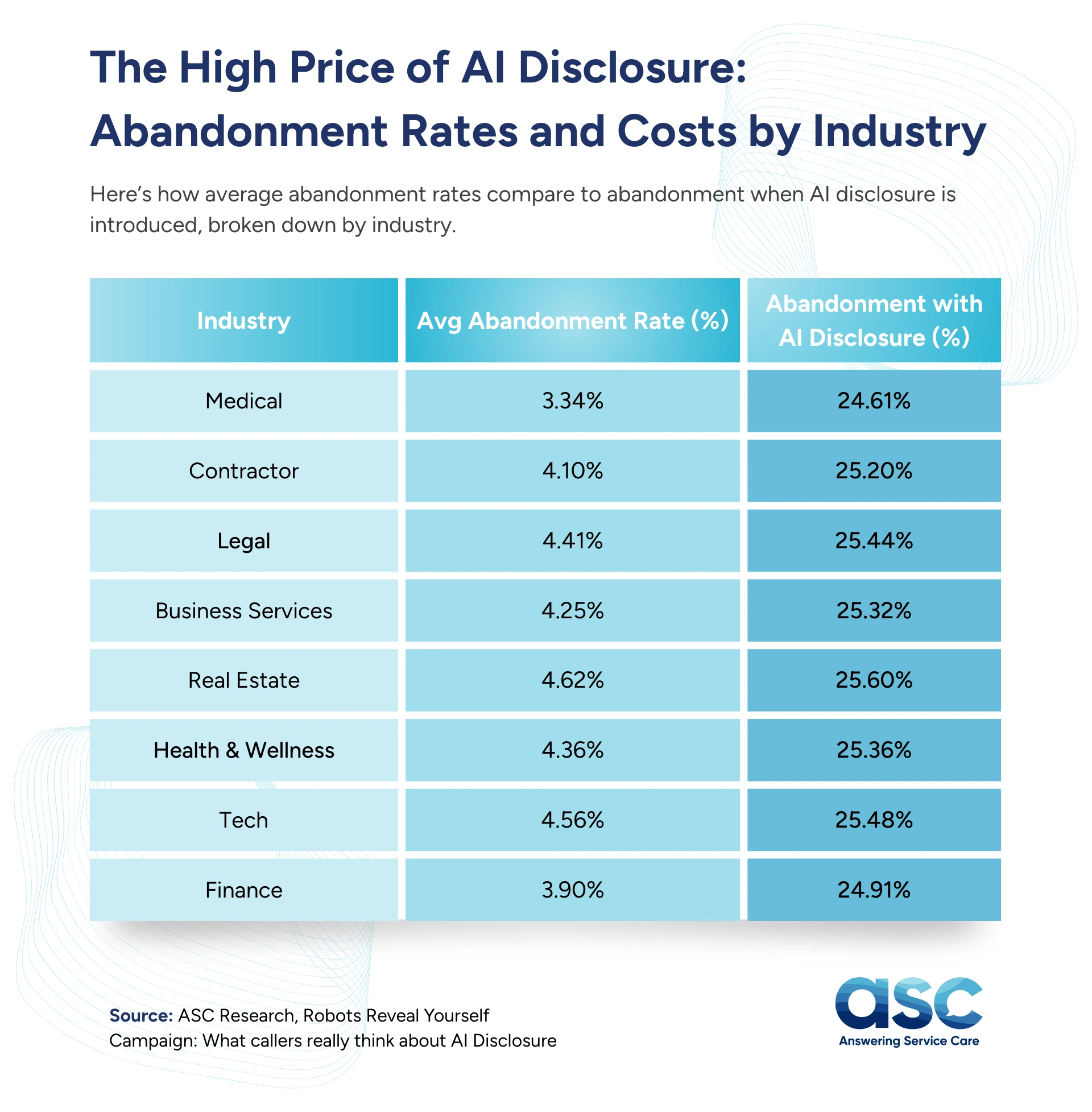
Looking at roughly one million calls handled by Answering Service Care’s live-human agents over the last three months, the average abandonment rate across industries was 4.04%. In sectors such as medical, contractor, and legal, where hundreds of thousands of calls came in, rates consistently stayed between three and five percent. That level of stability shows how ASC keeps customers on the line even in high-volume, high-stakes situations.
The contrast with AI disclosure is stark. While ASC maintains abandonment rates under five percent, disclosed AI drives them up to nearly 25%. This increase affects industries like healthcare, finance, real estate, and technology. That difference translates directly into outcomes. More patients reaching a hospital, more clients retained by law firms, and more opportunities secured by contractors and small businesses.
The financial consequences are just as stark for many service providers and SMEs. Contractors risk $227 each time someone hangs up, and legal services forfeit $649 in lost opportunities. For real estate services, each abandoned call costs an average of $448. Keeping abandonment at four percent instead of 25% prevents thousands in unnecessary losses.
Our survey findings reveal that callers are more likely to abandon interactions with AI, even when it’s disclosed, compared to when they speak with a human. That makes the stakes impossible to ignore. Disclosure remains non-negotiable as the ethical baseline, but it also proves a critical point: real people maintain trust and keep conversations moving where AI often falls short.
For SMEs, this difference can make or break the bottom line. Every call ASC answers represents a preserved relationship and a safeguarded opportunity, not a frustrated customer hanging up.
A live, transparent approach gives businesses the confidence to maintain trust and protect revenue.
Regulation that requires clear, upfront disclosure protects both sides. Customers get honesty, and businesses get a framework that reduces the risk of financial strain while strengthening trust over time.
The Future of AI Call Regulation
The future of AI call regulation is already being shaped abroad. The European Union’s AI Act makes disclosure a baseline requirement. India now compels telecom providers to announce when callers are speaking to a machine. Canada is advancing a framework to regulate “high-impact” AI systems by requiring risk assessments, transparency, and human oversight.
These laws don’t stop at their own borders. Multinational companies will find it easier to adopt a single global standard than to manage conflicting rules in every region. That means U.S. businesses may feel international pressure even before federal lawmakers act.
With new regulations on the horizon, disclosure is quickly becoming the global standard. The debate is no longer about whether AI should identify itself; the data makes that clear. The real question is what happens next. And the answer is simple: once disclosure is made, customers overwhelmingly choose humans. For businesses, that means every call answered by a live person isn’t just compliance. It’s the proven way to win trust, retain customers, and gain a competitive edge.
Public voices are reinforcing that urgency. Sid Rosenberg, a radio host on 77 WABC in New York, said, “100%. There needs to be both federal and state laws to regulate AI. In my own job, before I put anyone on the air, I have a responsibility to tell them that they are live on the air and that I am Sid Rosenberg. That same level of transparency should apply to AI. Regulation is essential.”
He also highlighted the broader problem of public awareness, stating, “The average person struggles just setting up their TV. Of course, they’re confused about AI. Most people simply don’t understand it.” Without stronger rules, secrecy thrives in that confusion.
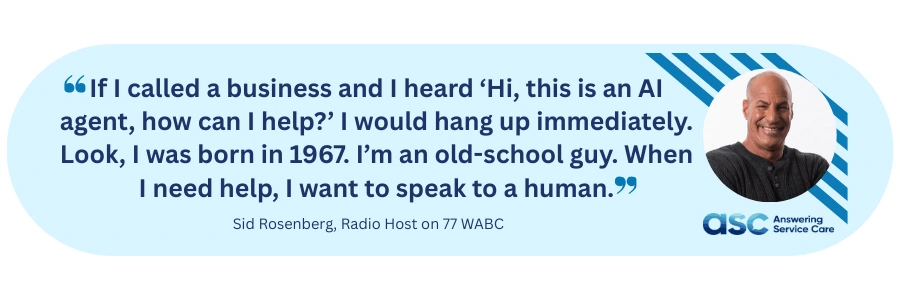
For Rosenberg, the danger is not just technical but human. “If I called a business and I heard ‘Hi, this is an AI agent, how can I help?’ I would hang up immediately. Look, I was born in 1967. I’m an old-school guy. When I need help, I want to speak to a human.”
Jay Shooster, a former Democratic candidate for the Florida House, echoed the call for action. “Laws regulating AI in consumer communications are absolutely necessary. Realistically, progress is more likely to begin at the state level, since passing legislation at the federal level is so difficult today. That said, both state and federal action are important, and ultimately both should play a role.”
Shooster emphasized that disclosure is not just a matter of fairness but of consumer choice. “Consumers deserve to know as soon as possible, at the very beginning of a call, chat, or interaction, that they are speaking with AI,” he said. “People should have the choice to decide whether they want to engage with AI or not. Without disclosure, we risk normalizing AI in ways that can contribute to increased social isolation and loneliness, particularly among younger generations.”
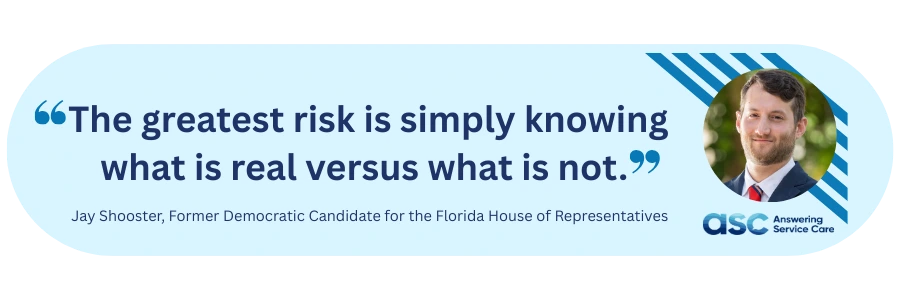
He also raised the risk of manipulation as AI becomes harder to distinguish from humans, stating, “The greatest risk is simply knowing what is real versus what is not. If AI becomes advanced enough to be indistinguishable from humans and is used without disclosure, consumers can be misled and manipulated. That’s a dangerous path, whether in customer service, healthcare, finance, or political communication.”
Shooster also drew parallels to past reforms. “There are strong precedents in privacy laws, call recording rules, robocall restrictions, and telemarketing regulations,” he explained. These earlier measures show that when new technologies reshape communication, lawmakers have stepped in to set guardrails that protect the public. “Policymakers should use these frameworks as a model for AI disclosure policy.”
On enforcement, Shooster was equally direct and made his position clear: “I fully support fines. The most effective approach would be a straightforward penalty, such as $500 per AI call without disclosure, that the state Attorneys General can enforce.”
Together, these perspectives highlight what international precedent, state action, and public opinion already suggest: disclosure is moving quickly from expectation to law. Nearly 80% of Americans support legal requirements. Several states are setting early standards, and bipartisan measures like the Keep Call Centers in America Act are gaining traction in Congress.
The U.S. now faces a choice. Businesses that adopt disclosure policies ahead of regulation will gain an advantage in trust and compliance, while those that wait risk being forced to change under stricter rules.
Conclusion
AI is rapidly becoming a fixture in customer service, but most callers still aren’t told when they’re speaking to it. That secrecy carries a steep price.
More than a third of consumers say they would lose trust in a company that hides AI, one in four call the experience “betrayal,” and abandoned calls already cost SMEs thousands in lost revenue. Hidden AI only heightens those risks.
The answer? It’s time for mandatory disclosure. Modeled on call recording and privacy laws, clear disclosure standards would protect consumers, reduce abandonment, and give small businesses consistency instead of compliance guesswork.
Other regions across the globe are already moving in this direction. The European Union’s AI Act makes disclosure a legal requirement, India’s telecom authority mandates upfront AI announcements, and Canada’s proposed AIDA would regulate high-impact AI systems through risk assessments, transparency, and oversight.
While some U.S. states like California are leading the charge, the country as a whole is falling behind.
Answering Service Care believes it’s time to catch up. Through the newly formed ASC AI Disclosure 501(c)(3), we are working to push this issue onto legislative agendas while giving businesses and consumers a stronger voice in the debate. By demanding transparency now, we can set a higher bar for customer service and prevent regulation from arriving too late.
Together, we can build a future where AI serves openly, and where businesses and consumers both benefit from trust instead of secrecy.
Explore our interactive map to see where your state stands, share these findings, and use our pre-written letter to urge your local officials to support AI disclosure laws.
Methodology
This report draws on nationwide surveys of 2,000 U.S. consumers and 250 SME business owners conducted in 2025. The consumer survey measured perceptions of AI in customer service, from trust and disclosure preferences to industry-specific concerns in banking, healthcare, and emergency services. The SME survey examined risks tied to call abandonment, compliance, and customer confidence.
We compared perception and performance by analyzing over one million calls handled by Answering Service Care in three months. During this time, the abandonment rate averaged 4.04% across industries. We contrasted these results with projected abandonment rates near 25% when users received disclosure about AI usage. Additional desk research covered state and international laws, including California’s SB-942, the EU’s AI Act, India’s telecom disclosure rules, Canada’s AIDA proposal, and the Keep Call Centers in America Act of 2025. Expert commentary from media and political figures added qualitative context, highlighting both regulatory urgency and the human importance of transparency in customer service.