
San Francisco, CA Answering Service

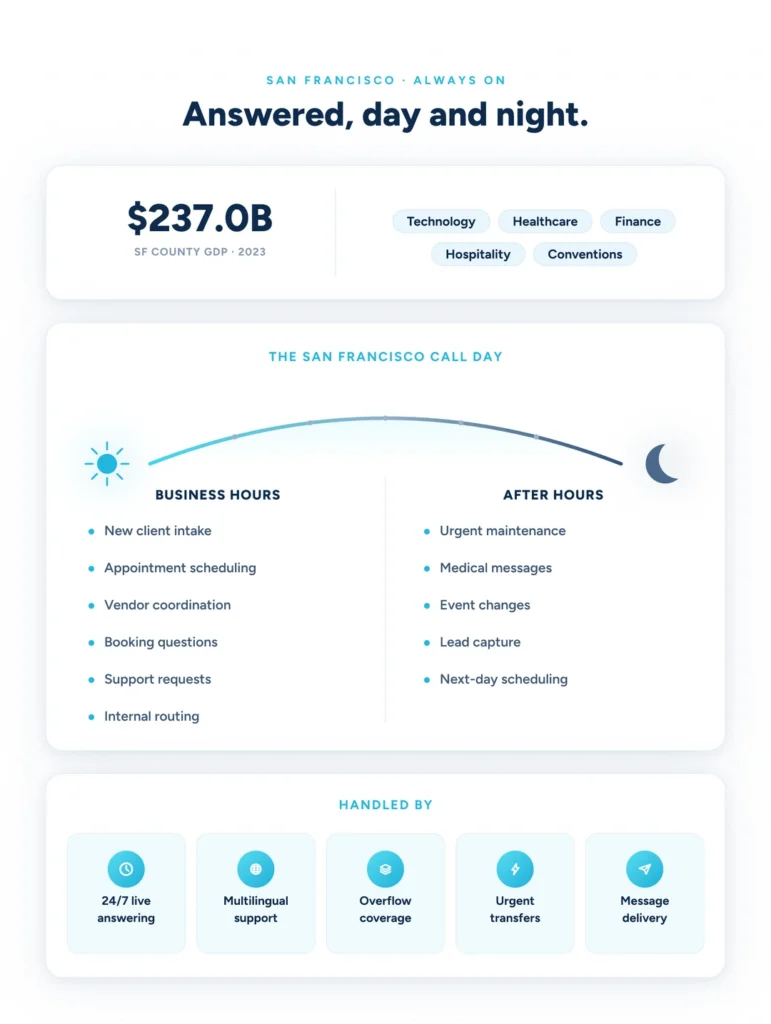
Serving San Francisco, CA, our answering service helps local businesses stay reachable without tying every important call to a single front desk, employee schedule, or office line. San Francisco County’s real GDP reached about $237.0 billion in 2023, and the city continues to draw business activity across technology, healthcare, finance, hospitality, and convention-driven commerce. In a market where callers often expect a fast answer and a clear next step, missed calls can create friction quickly.
That pressure shows up in the daily call mix. During business hours, calls often involve new client intake, appointment scheduling, vendor coordination, booking questions, support requests, and internal routing between teams. After hours, the mix often shifts toward urgent maintenance issues, medical messages, event changes, lead capture, and next-day scheduling needs. Our live and AI answering services give San Francisco businesses a more structured way to handle those calls without forcing internal staff to cover every gap themselves.
Businesses across San Francisco use our service for:
- 24/7 live answering
- Multilingual receptionist support
- After-hours and overflow coverage
- Urgent call transfers
- Message delivery by text, email, app, or portal
A live operator can answer using your business name, follow your instructions, capture the right details, transfer priority calls when needed, and send messages by text, email, app, or secure portal. That allows a San Francisco virtual receptionist setup to support daily operations while giving your team more control over how calls are handled during busy hours, after hours, and overflow periods.
Why 415 and 628 Numbers Still Matter Across San Francisco ZIP Codes
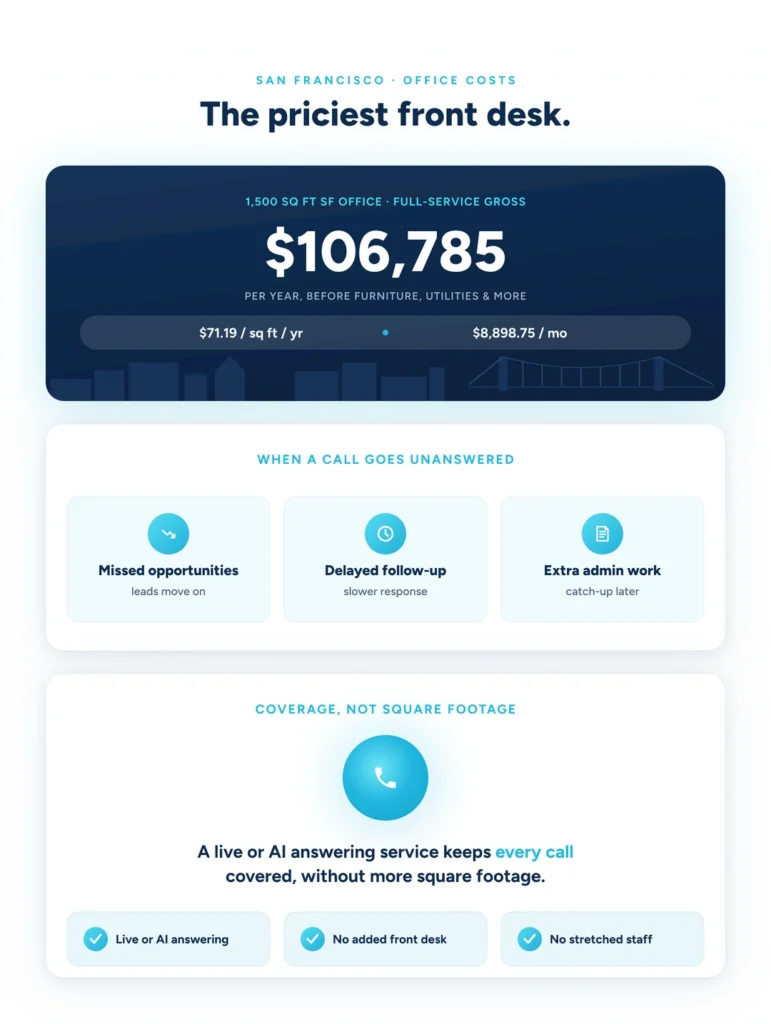
San Francisco businesses primarily operate within the 415 area code and the 628 overlay. Those local identifiers still matter because callers often make quick judgments based on whether a number feels familiar and local. A San Francisco virtual receptionist paired with a recognizable local number can make the first interaction feel more credible and more connected to the market you serve.
ZIP code coverage matters for the same reason. San Francisco ZIP codes include 94102, 94103, 94104, 94105, 94107, 94108, 94109, 94110, 94111, 94112, 94114, 94115, 94116, 94117, 94118, 94121, 94122, 94123, 94124, 94127, 94129, 94130, 94131, 94132, 94133, 94134, and 94158. Those ZIPs cover downtown offices, Mission Bay medical and tech campuses, neighborhood service routes, and waterfront commercial areas.
That means businesses often need call handling that reflects the different parts of the same market, rather than a single, generic phone process. A local answering service can help by providing callers with a live point of contact while keeping routing and message delivery organized behind the scenes.
What High San Francisco Office Costs Mean for Front Desk Coverage
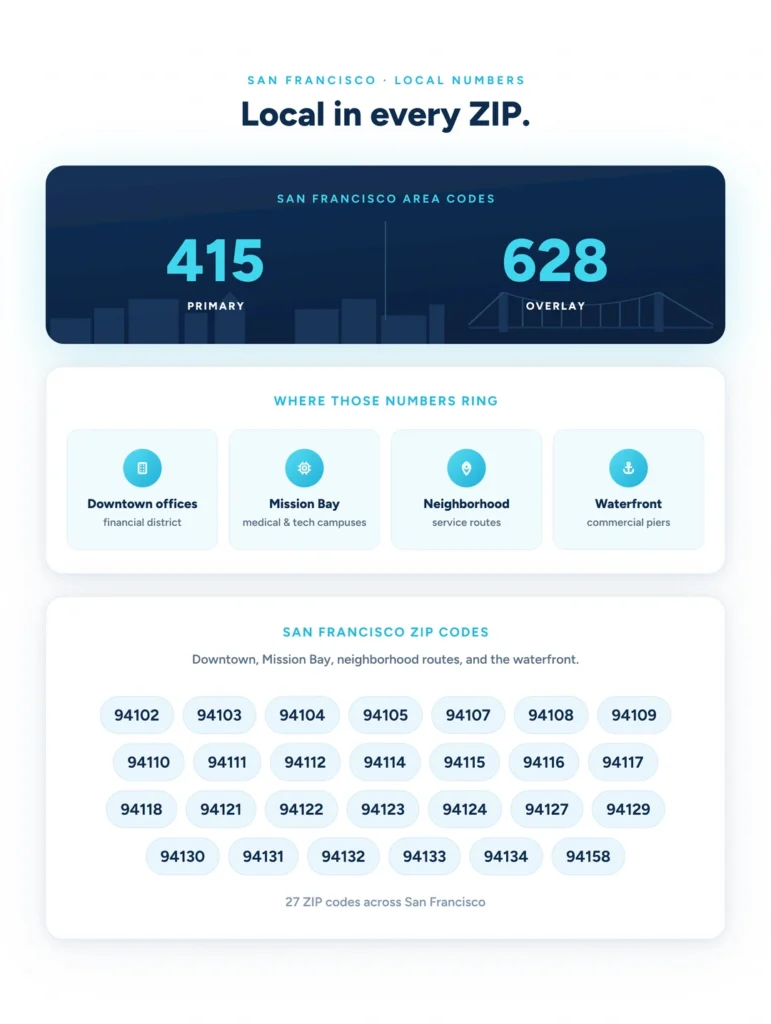
Office costs in San Francisco remain a significant overhead. CBRE reported that the San Francisco office market’s average asking rate was $71.19 per square foot on an annual, full-service gross basis in Q1 2026. At that rate, a 1,500-square-foot office comes to about $106,785 per year, or roughly $8,898.75 per month, before furniture, equipment, insurance, utilities, and other occupancy costs are added.
Many first interactions no longer happen in the lobby. They happen on the phone while staff are in meetings, with clients, on-site, or moving between departments. When that happens, missed calls can turn into missed opportunities, delayed follow-up, and extra administrative work.
A San Francisco answering service gives businesses another way to maintain live coverage without expanding front desk space or overstretching internal staff. Instead of building around a single desk or schedule, businesses can create a call-handling process better aligned with how their team actually works.
Why Reliable Phone Coverage in San Francisco Takes Planning
Maintaining dependable call coverage in San Francisco usually requires more than assigning calls to a single receptionist. Employers must account for the city’s $19.18 minimum wage, effective July 1, 2025, through June 30, 2026, along with paid sick leave rules that require accrual at one hour for every 30 hours worked. Employers with 10 or more employees may cap balances at 72 hours.
That challenge is even more noticeable in San Francisco, where teams may be split between downtown offices, Mission Bay campuses, fieldwork, and customer-facing operations tied to events and visitor traffic. Even businesses with strong internal staff can find that coverage becomes inconsistent when call volume rises or schedules shift unexpectedly.
That is one reason many San Francisco businesses compare in-house staffing to answering service support, rather than assuming the front desk is the simplest or most efficient option. A live receptionist service can provide steadier coverage across hours and situations where internal availability fluctuates.
Reception Payroll in San Francisco and What It Really Covers
BLS data show that receptionists and information clerks in the San Francisco-Oakland-Hayward metro area averaged $22.81 per hour in May 2022. That works out to about $47,444.80 annually in base wages for a full-time, 40-hour-per-week schedule before taxes, paid leave, training time, and backup coverage are factored in.
Base wage is only part of the picture. Employer cost data also track additional compensation such as paid leave, insurance, retirement, and legally required benefits. When you add the need for backup coverage, overflow handling, and longer service windows, what looks like one front desk role can start functioning more like a multi-person system. That is why many businesses compare in-house staffing with virtual receptionist support rather than focusing solely on hourly wages.
Coverage also does not stay static. Lunches, absences, seasonal spikes, and longer service windows can turn what looks like one role into a multi-person system. That is one reason many San Francisco businesses compare in-house reception staffing with virtual receptionist coverage rather than assuming the front desk is the default lower-cost option.

Answering Service Care plans start at $40 per month. For businesses that need live answering without building out full in-house coverage, comparing the cost of a receptionist and live answering can become part of a broader staffing and operations decision.
What Drives Inbound Calls Across the San Francisco Market
San Francisco’s business mix creates a constant need for organized call handling. The city combines major technology and professional employers, large healthcare institutions, and a visitor economy tied to hotels, conventions, restaurants, and cultural activity.
That mix shapes the call flow. One business may need lead qualification and support escalation. Another may need patient intake and appointment routing. Another may need booking changes, vendor coordination, or after-hours message capture. The industries differ, but the operational need stays consistent. Calls have to be answered, documented clearly, and sent to the right person quickly enough for the business to act.
That is why answering service support is rarely just about message taking. Businesses often need a process that can adapt to urgency, scheduling, service lines, and internal routing rules without requiring callers to repeat themselves or wait until the next business day.

San Francisco remains one of the country’s most important technology and innovation markets. The city’s recent AI momentum includes OpenAI’s expansion in Mission Bay and Databricks’ announced investment in the city, while Salesforce and other large technology employers continue to shape the local business environment. That concentration creates a steady flow of calls tied to product inquiries, sales follow-up, recruiting, billing questions, partner coordination, and technical support.
In firms where employees spend long stretches in meetings, focused work, or client delivery, unanswered calls quickly create a bottleneck. Prospects want a response, current clients want updates, and vendors want confirmation that the right team received the message. Structured live answering gives these businesses a reliable intake layer without forcing technical or client-facing staff to interrupt their work every time the phone rings.
For San Francisco technology and professional services firms, answering service support can help with:
- lead capture for demos, consultations, and new business inquiries
- routing support requests to on-call or department-specific contacts
- intake notes sent into CRM or ticketing workflows
- bilingual call handling for English- and Spanish-speaking callers
- after-hours message capture during launches, events, and support spikes
Healthcare is deeply woven into San Francisco’s daily operations. City materials reference UCSF Health, Kaiser, California Pacific Medical Center, and Zuckerberg San Francisco General Hospital as major parts of the local care system, and Mission Bay remains closely tied to major health centers and research activity. In practical terms, that means large call volumes tied to appointments, referrals, prescription-related messages, patient questions, follow-up communication, and after-hours concerns.
These calls need structure because they often involve timing, privacy, and multiple departments. A caller may need scheduling help, a provider callback, instructions for the next step, or a message routed in accordance with on-call rules. Answering Service Care’s medical answering service is built around those needs with live operators, HIPAA-trained staff, structured patient intake, and appointment scheduling support so practices can stay reachable without overloading clinical teams.
For San Francisco healthcare and life sciences organizations, answering service support can help with:
- appointment scheduling, cancellations, and rescheduling requests
- structured patient intake for urgent and routine calls
- referral and follow-up message capture
- after-hours escalation to on-call clinicians or administrators
- HIPAA-conscious message handling and secure delivery options
Hospitality remains a major source of business activity and inbound calls in San Francisco. San Francisco Travel projected 23.22 million visitors and $9.24 billion in visitor spending for 2024, with additional growth forecast for 2025 alongside a stronger Moscone convention calendar. Those conditions create steady communication needs for hotels, restaurants, venues, tour operators, and businesses tied to convention traffic.
Calls in this part of the market often involve reservations, event changes, group questions, vendor updates, rooming issues, delivery coordination, and after-hours guest concerns. Live answering helps keep those conversations moving when on-site teams are already focused on guests, events, or service delivery. Fast message relay becomes especially useful when the next step cannot wait until morning.
For San Francisco hospitality and visitor-service businesses, answering service support can help with:
- reservation and booking inquiry capture
- event and convention-related message routing
- vendor and delivery coordination updates
- after-hours guest issue documentation and escalation
- rapid message relay to managers, supervisors, or on-call staff
San Francisco businesses often need phone coverage that can keep pace with busy schedules, shifting priorities, and uneven call volume. Medical practices handle patient messages, technology firms field sales and support calls, hospitality teams manage reservations and guest questions, and professional offices juggle intake, routing, and follow-up.
That is why many businesses use live and AI answering service support to create a more organized intake process. Calls can be answered in your business name, documented clearly, routed based on urgency, and sent to the right person without adding more strain to your internal team. This helps reduce incomplete messages, delayed follow-up, and unnecessary back-and-forth.
Support is especially useful when employees are unavailable, after-hours issues arise, or routine calls need to be separated from those that require immediate attention. With multilingual support, appointment-related intake, secure message delivery, department and on-call routing, and an AI answering service for routine calls, businesses can stay responsive while keeping employees focused on their core work.
Answering Service Tools Built for San Francisco Workflows
Call handling in San Francisco often involves working across different departments, with changing schedules and periods of uneven demand. Some businesses need calls sorted by urgency, some need them directed by department or on-call responsibility, and others need coverage that changes depending on the hour, location, or service line.
Because San Francisco businesses operate across a wide range of office, clinical, hospitality, and mobile environments, the phone process should reflect how the business already operates rather than forcing everyone into the same setup.
San Francisco businesses often need calls routed by urgency, department, time of day, service line, or on-call schedule. Answering Service Care can support live answering during business hours, overflow coverage when call volume rises, and after-hours answering for evenings, weekends, and holidays.
Our answering service can support:
- live answering aligned with your business hours
- custom greetings and intake steps based on your process
- urgent transfers for time-sensitive situations
- routing by urgency, department, schedule, or on-call contact
- message delivery by text, email, app, or portal
- multilingual support for English, Spanish, and more
- organized intake for scheduling and appointment-related calls
- clear documentation for cleaner internal follow-up
Additional support may include CRM, calendar, or ticketing integrations, as well as secure message handling for businesses that manage sensitive communication. That gives San Francisco teams a more organized way to handle incoming calls without adding more internal strain.
How an Answering Service Fits San Francisco Workflows
A San Francisco answering service provides businesses with a reliable way to manage inbound calls without expanding internal staff or diverting employees from client work, fieldwork, or day-to-day operations. Coverage can be adjusted based on timing, call volume, and urgency.
Support may include:
- live answering during business hours, after hours, weekends, and overflow periods
- custom greetings and intake questions tied to your process
- urgent transfers and message relay to designated on-call contacts
- appointment or scheduling support when appropriate
- multi-lingual call handling for English- and Spanish-speaking callers
- secure message delivery by text, email, app, or portal
- CRM, calendar, or ticketing integrations for cleaner follow-up
- AI answering support for routine inquiries, basic intake, and after-hours coverage
Frequently Asked Questions:
Yes, ASC provides 24/7 live answering for after-hours, overflow, weekends, and holidays.
Yes, calls can be answered in your business name using your greeting, script, and intake instructions.
Absolutely, urgent calls can be routed using on-call schedules, escalation paths, and industry-specific workflows.
Multilingual support is available. Our U.S.-based multilingual receptionists can help businesses serve both English- and Spanish-speaking callers more effectively.
Yes, most businesses can keep their existing number and forward calls during selected hours, overflow periods, or after-hours coverage.
Yes. ASC offers an AI answering service for businesses that want another option for handling routine calls, supporting overflow, or extending coverage hours.
Supporting Businesses Across San Francisco and the Bay Area
Different parts of San Francisco create different communication needs. Downtown and Financial District firms often need lead intake, client messages, and department routing handled cleanly. Mission Bay teams may need support for healthcare, research, or AI-related calls while staff are in clinics, labs, or meetings. Businesses tied to Moscone and visitor traffic may need overflow coverage during conventions, event weeks, and demand spikes.
Coverage can also be organized around your actual service footprint. Some businesses work from a single office but serve callers across multiple San Francisco ZIP codes. Others answer from San Francisco while serving customers across the broader 415 and 628 territory. In both cases, call handling can be aligned with neighborhoods, departments, on-call schedules, and secure delivery rules so the phone process aligns with how the business already operates.
How Call Forwarding Works with Your Existing San Francisco Number
Getting started usually does not require a new number. If your business uses AT&T, Verizon, T-Mobile, or Comcast Business, each provider offers call-forwarding options that can send calls to another destination. Depending on your setup, forwarding can be used all the time, only when lines are busy, or only when no one answers.
That means you can keep the number your customers already know while adding live receptionist coverage behind the scenes. Answering Service Care’s setup process is designed around personalized greetings and call forwarding, so businesses can add live coverage without changing how callers reach them. It is a simple way to improve response handling while keeping control over your current phone experience.
- What an SF Area Code Tells Your Callers
- Office Rent and Why Phone Coverage Pays Off in SF
- California Wage Rules Shaping SF Staffing
- What It Costs to Staff a Front Desk in SF
- The Industries Keeping SF Phones Busy
- Answering Features Suited to SF Businesses
- How Live Answering Slots into SF Operations
- SF Answering Service FAQ
- Why SF Companies Count on Live Answering
- Forwarding Calls from an SF Number