
Albany Answering Service

Albany sits at the center of New York’s Capital Region, where government offices, healthcare systems, universities, and professional firms operate alongside a growing technology sector. Organizations across the metro rely on direct phone communication to coordinate appointments, intake requests, and operational decisions that often cannot wait for email responses. Answering Service Care provides Albany answering service coverage, overflow, and after-hours, with live receptionists, escalation tiers, and secure message delivery, so callers reach a real person instead of voicemail.
Businesses in Albany commonly experience steady daytime call traffic supported by administrative offices, healthcare providers, and regional service firms. After hours, calls can be prioritized through escalation tiers that determine whether a message is logged for the next business day or patched through to an on-call contact. Medical offices manage patient inquiries beyond clinic hours. Property managers address maintenance issues. Government contractors coordinate projects and compliance matters tied to strict timelines.
Public sector schedules, healthcare coordination, and professional service timelines create tight response expectations across Albany’s business community. Missed calls introduce immediate friction. Operators can transfer urgent calls directly, capture structured intake notes for follow-up, or send secure messages to on-call staff based on the rules you define.
Our Albany answering service provides live receptionist coverage for business-hours overflow and after-hours calls by answering with your script, collecting intake details, and transferring or securely messaging your team based on urgency. Calls are answered live, documented clearly, and routed according to your instructions, so your internal team can focus on core responsibilities rather than managing every inbound call.
What Capital Region Phone Numbers Signal to Callers
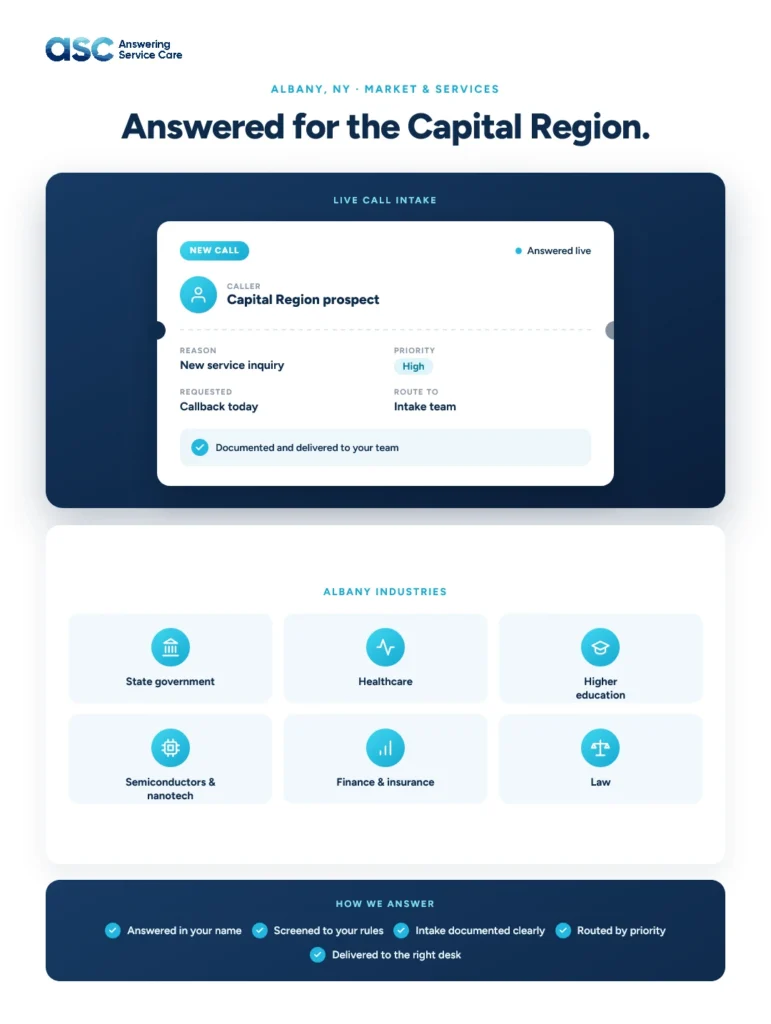
A local phone number helps establish familiarity with callers across the Capital Region. Businesses in Albany typically use the 518 and 838 area codes, which serve Albany, Schenectady, Troy, Saratoga Springs, and surrounding communities throughout northeastern New York. Using a 518/838 number plus a live Albany virtual receptionist helps callers reach a real person quickly, improving first-call resolution for appointments, intake, and urgent issues.
Albany organizations frequently support customers across ZIP codes such as 12203, 12205, 12206, 12207, 12208, 12209, and 12210. These ZIP codes cover downtown Albany, the Empire State Plaza district, major residential neighborhoods, and nearby commercial corridors where healthcare offices, law firms, and administrative agencies operate.
Using a local number with live call handling strengthens caller confidence from the first ring. Instead of reaching voicemail or a remote queue, callers connect with a live professional who captures details and routes messages in accordance with your escalation procedures.
Commercial Space Costs in Albany and How They Shape Operations
Commercial real estate costs in Albany are lower than those in larger metropolitan areas such as New York City, yet office space still represents a meaningful operating expense for many organizations.
Across much of the Capital Region, office leasing rates typically range from $20 to $28 per square foot annually, depending on building class and location. Downtown Albany, the Empire State Plaza area, and newer office parks near Interstate 87 typically sit toward the higher end of that range.
A modest 1,500-square-foot office leased at $24 per square foot would translate to roughly $36,000 per year in base rent, or approximately $3,000 per month before utilities, maintenance fees, parking, insurance, and furnishings are included.
Even in smaller offices, there is a fixed monthly commitment that does not change with how frequently the phone rings. For businesses that primarily interact with clients by phone rather than in person, maintaining a staffed reception desk can tie communication coverage directly to square footage.
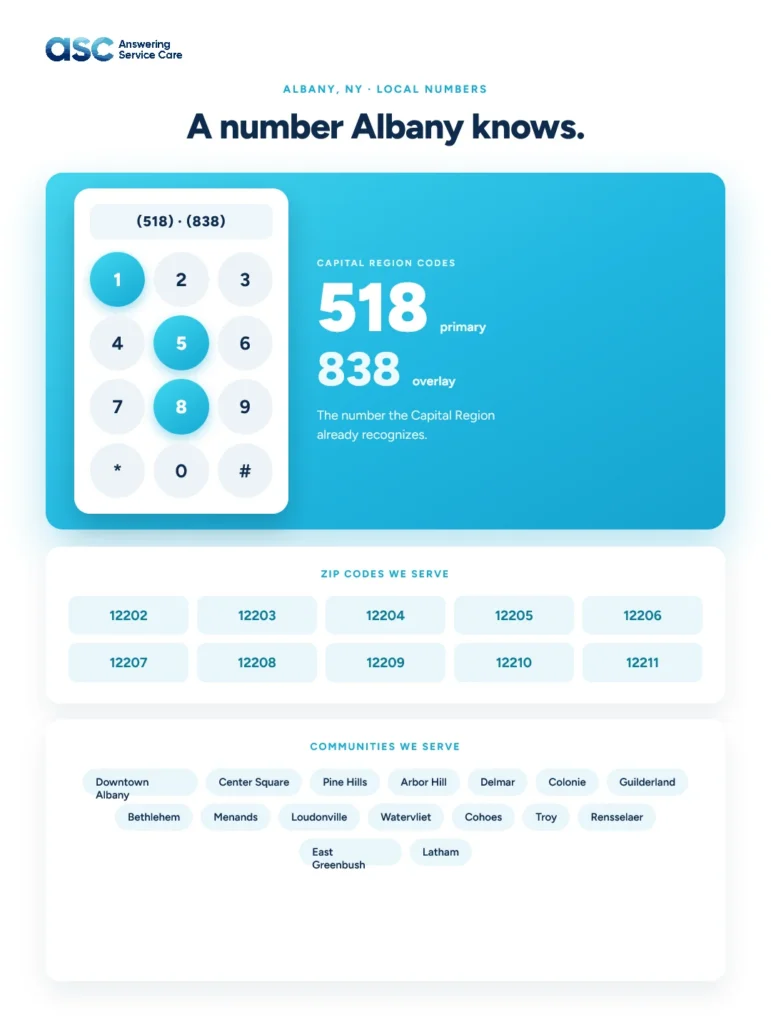
An Albany answering service separates phone accessibility from physical office space. Organizations maintain professional call coverage while reducing the need to dedicate floor space and staffing resources solely to front-desk responsibilities.
What It Takes to Staff Phones Under New York Employment Law
Managing phone coverage internally requires businesses to navigate both New York State labor law and federal employment regulations. These rules shape staffing schedules, payroll budgets, and overtime exposure.
New York minimum wage rules vary by region and change over time; once you account for wage floors, overtime, and paid leave coverage, staffing phones internally can become significantly more expensive than it appears. Employers must also comply with federal overtime standards under the Fair Labor Standards Act, which require non-exempt workers to receive time-and-a-half pay for hours exceeding forty in a workweek.
New York’s Paid Sick Leave law also applies to many employers. When administrative staff take leave or scheduled time off, businesses still need to maintain uninterrupted phone access. This frequently leads organizations to cross-train additional staff members or expand administrative headcount.
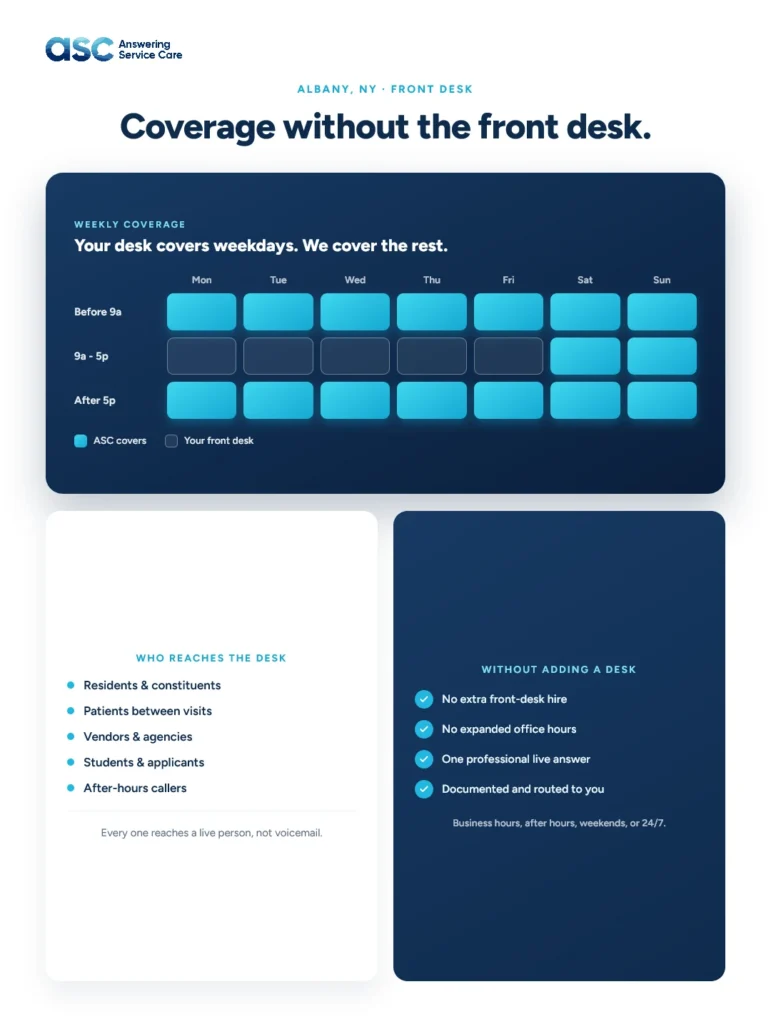
For Albany companies with steady inbound calls, these combined requirements create predictable staffing obligations. Many organizations evaluate answering services to maintain reliable call intake while avoiding the complexity of layered scheduling and the costs of expanding payroll.
Front Desk Receptionist Compensation in the Albany–Schenectady–Troy Metro
Local wage data helps illustrate the real cost of maintaining internal phone coverage. According to the U.S. Bureau of Labor Statistics, the Albany–Schenectady–Troy metropolitan area reports a high number of administrative roles. Receptionist compensation typically falls between $35,000 and $40,000 annually, depending on hours, benefits, and experience. Additional labor costs, such as payroll taxes, training, benefits, and paid leave, can increase the total cost of maintaining front-desk coverage.
Ensuring phones remain answered during breaks, vacations, and unexpected absences often requires multiple employees supporting a single position.

Virtual receptionist plans at ASC begin at $40 per month, allowing Albany businesses to maintain professional phone coverage while avoiding tens of thousands of dollars in annual staffing expenses.
Albany’s Economic Structure and the Sectors Driving Communication
Albany functions as the administrative and institutional center of New York’s Capital Region, supporting a metropolitan population of roughly 900,000 residents and a workforce closely tied to state government operations, healthcare systems, and higher education institutions.
While smaller than major financial centers, the region plays an important role in public administration, regional healthcare delivery, and academic research across upstate New York. State agencies, hospital networks, universities, and professional service firms generate a substantial share of economic activity while operating within structured environments shaped by regulatory timelines, patient care coordination, and academic schedules.
Many interactions follow strict timelines tied to government deadlines, clinical appointments, and academic calendars. Operators can document caller requests in structured message formats and route them through email, SMS, or secure dashboards so your team receives the information quickly and clearly.
Answering Service Care’s Albany virtual receptionist service supports these organizations by capturing inquiries, documenting key details, and routing calls appropriately while internal teams remain focused on policy administration, patient care, and institutional operations.

Government and Public Administration form the institutional core of Albany’s economy. As the capital of New York State, the city hosts the New York State Capitol, the Empire State Plaza complex, and dozens of state departments and regulatory agencies that oversee public programs, licensing systems, and statewide policy administration. Major agencies headquartered in Albany include the New York State Department of Health, Department of Environmental Conservation, Department of Financial Services, and the Office of the State Comptroller, along with numerous boards, commissions, and legislative offices.
Government activity extends beyond the Capitol itself. Albany supports a network of policy consultants, legal practices, engineering firms, public affairs groups, and nonprofit organizations that work closely with state agencies on infrastructure projects, regulatory compliance, and public program implementation. Contractors coordinate on transportation initiatives, healthcare providers engage with regulatory departments, and financial institutions interact with oversight agencies that supervise banking and insurance operations across New York.
Legislative sessions, regulatory updates, procurement cycles, and statewide program administration depend on consistent coordination between departments, contractors, and the public, positioning Albany as a central hub for organizations that interact with state government.
Healthcare and Life Sciences are among the largest sectors in the Albany–Schenectady–Troy metropolitan economy. Major institutions such as Albany Medical Center, St. Peter’s Health Partners, and the Albany Stratton VA Medical Center anchor a regional healthcare network that serves patients across northeastern New York and parts of western New England. Surrounding these hospitals is a broad system of specialty clinics, outpatient centers, rehabilitation facilities, and research organizations.
Healthcare operations involve constant coordination between providers, insurers, laboratories, pharmacies, transportation services, and long-term care facilities. Administrative teams schedule procedures, manage physician referrals, verify insurance requirements, and coordinate follow-up care for patients who often travel significant distances to receive treatment in Albany.
Academic partnerships also strengthen the region’s healthcare sector. Organizations affiliated with Albany Medical College and regional universities collaborate on clinical research, biomedical innovation, and medical education programs that bring together hospitals, faculty, and research partners throughout the Capital Region.
High-technology development has become an increasingly important part of the Capital Region’s economy. Albany supports a growing cluster of semiconductor research, biotechnology development, and clean energy innovation anchored by the Albany NanoTech Complex and the broader SUNY Polytechnic Institute ecosystem.
Semiconductors and advanced electronics form the foundation of this cluster. Technology companies and research organizations collaborate at Albany NanoTech on next-generation chip manufacturing, materials science, and microelectronics design. Firms such as IBM and partners connected to GlobalFoundries contribute to research programs that connect the Capital Region to global semiconductor supply chains.
Biotechnology research and cleantech development further expand the region’s innovation economy. Medical research groups, technology startups, and environmental engineering teams collaborate on projects related to biomedical technology, energy systems, and advanced materials that support New York’s broader climate and technology initiatives.
Advancements in semiconductors, biotechnology, and clean energy research continue to strengthen Albany’s position as a regional hub where public investment, academic research, and private industry collaborate to develop emerging technologies.
Albany’s leading industries rely on timely and accurate communication to keep operations moving. Government agencies coordinate regulatory programs and contractor activity. Healthcare providers manage patient care schedules and referrals. Technology and research organizations oversee semiconductor development, biomedical innovation, and energy system research, often involving partners across multiple institutions.
When communication slows, operations slow with it. Urgent requests can be escalated immediately to designated contacts, while routine calls are logged and delivered in structured summaries.
Albany virtual receptionists provide a clear point of contact the moment a caller reaches your number. Instead of sending callers to voicemail, trained operators answer calls in your company’s name, document the conversation, and follow predefined handling instructions. Messages are recorded in real time and delivered through secure channels, so your team receives accurate information without needing to retrieve voicemails or search through multiple systems.
Calls can be transferred directly to designated staff members, with transfer rules controlling which contacts receive calls during business hours, after hours, or during emergencies. Businesses define call patching rules that determine which staff members receive transfers, when calls should be escalated, and how after-hours requests are handled. Urgent issues can move through structured escalation tiers, ensuring that time-sensitive matters reach the appropriate person quickly while routine messages are documented for later follow-up.
Capital Region coverage can include bilingual operators, appointment-scheduling integrations, and secure message delivery, all of which support regulated industries such as healthcare and legal services. Live answering provides a structured intake process that keeps communication organized even when internal teams are unavailable.
How Answering Service Care Supports Albany Organizations
Across Albany’s professional services community, responsiveness shapes how callers perceive a company. A live answer signals organization and reliability. Voicemail often signals a delay, especially when callers contact multiple providers within a short period.
Our Albany answering service creates a consistent intake system for every inbound call. Operators follow customized scripts that reflect your business processes, gathering new caller information, capturing detailed messages, and documenting requests in a structured format. For organizations that schedule appointments by phone, operators can use supported scheduling platforms to book or confirm meetings while the caller remains on the line.
Call handling can also include bilingual support when needed, helping businesses communicate clearly with a wider range of callers across the Capital Region. At the same time, spam and robocalls can be filtered before they reach internal staff, reducing interruptions throughout the workday.
Security and confidentiality remain central to the process. Messages can be delivered through secure systems that support industries with strict privacy expectations, including HIPAA-sensitive healthcare communication and confidential intake for legal or financial services.
For Albany organizations balancing administrative responsibilities with client-facing work, structured call answering provides dependable coverage without requiring additional staff or extended schedules. Calls are answered live, documented clearly, and routed according to your instructions so your team can focus on the work that requires their direct attention.

Our Albany answering service helps businesses across the Capital Region manage inbound calls without expanding internal staff. Services include:
- Live call answering during business hours, overflow periods, or after hours
- Custom greetings and intake scripts based on your workflows
- Urgent call transfers and escalation tiers for time-sensitive issues
- Appointment scheduling and new caller intake
- Bilingual answering options when needed
- Spam and robocall filtering
- Secure message delivery via SMS, email, or dashboard notifications
- HIPAA-conscious handling for healthcare and confidentiality for legal services
Calls are answered live, documented clearly, and routed according to your instructions so your team can stay focused on daily operations.
Serving Businesses Throughout the Capital Region
Different areas generate different call patterns. For example, a Latham property manager may need weekend maintenance escalation, while a downtown Albany contractor may need weekday call patching during bid windows. Downtown offices often see concentrated weekday activity tied to government agencies and professional firms. Residential and suburban areas generate more evening and weekend inquiries from service businesses and healthcare providers.
Answering Service Care provides live answering services for organizations across Albany, NY, and the broader Capital Region, including Schenectady, Troy, Colonie, Latham, Guilderland, and Saratoga Springs. Businesses can contact our team directly to learn how live receptionist coverage can support their operations.
Our team adapts to these patterns, delivering consistent live answering coverage tailored to each organization’s hours, escalation preferences, and industry requirements. Call details are documented in secure systems and delivered to your team through controlled channels such as SMS, email, or a secure dashboard. Access to messages can be limited to authorized contacts, helping organizations maintain confidentiality while ensuring important information reaches the right person quickly.
Forwarding Albany Business Calls Without Changing Your Number
Businesses in Albany commonly rely on major telecom providers for both mobile and office phone service. The most widely used carriers in the region include AT&T, Verizon Wireless, and T-Mobile, all of which provide extensive coverage throughout the city and surrounding areas. Broadband and business phone services are also frequently provided by Spectrum Business and Comcast.
Each of these providers offers call forwarding, allowing companies to redirect incoming calls to a professional answering service while keeping their existing business number.
Forwarding can be configured in several ways at Answering Service Care. Some organizations activate it around the clock, while others use it only after hours or during busy periods when internal staff cannot answer every call.
Our call-forwarding guides provide step-by-step instructions for major carriers so Albany businesses can activate coverage quickly while maintaining a seamless caller experience.