
New York City Answering Service


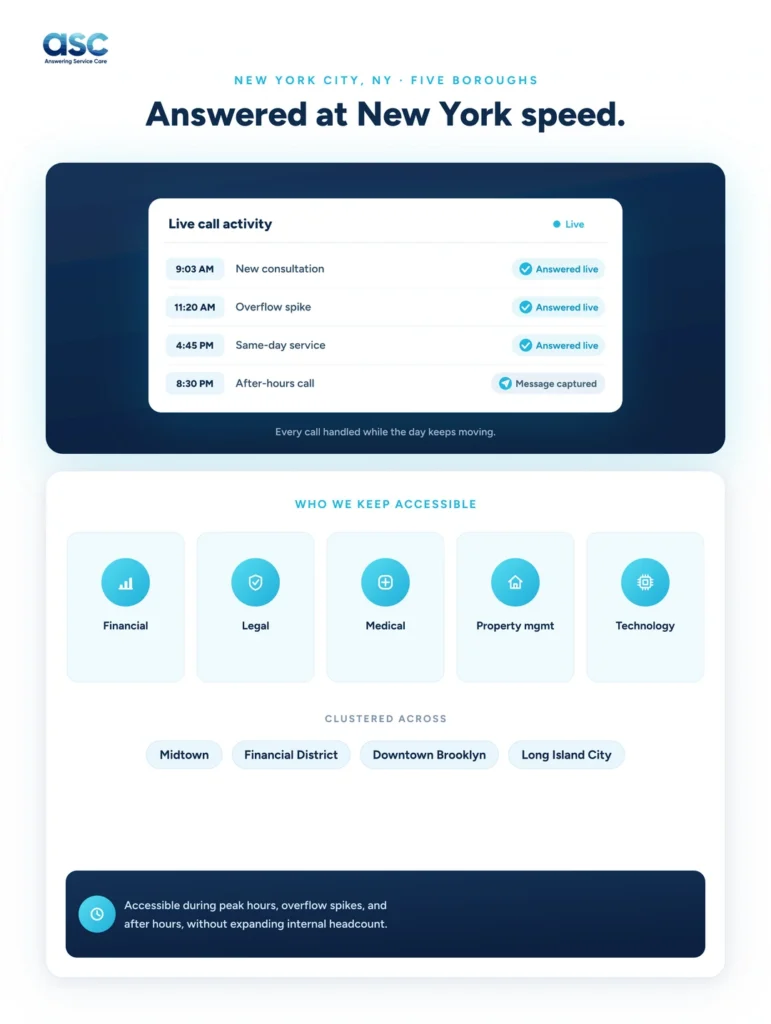
In New York City, competition is dense, and response windows are short. Callers often contact multiple providers within minutes, especially in industries clustered across Midtown, the Financial District, Downtown Brooklyn, and Long Island City. A missed call at 9:03 a.m. can mean a lost consultation before markets open. An unanswered line late in the afternoon can cost a same-day service appointment.
Business owners here also operate under some of the highest fixed overheads in the country. Between labor expenses and office space rental costs, even small operational decisions carry financial weight. Many organizations evaluating how to structure phone coverage are not simply looking for convenience. They are trying to determine how responsiveness, cost control, and reputation intersect in a market that moves quickly.
New York City’s call patterns reflect that pace. Financial institutions coordinate across global time zones. Law firms manage court calendars and filing deadlines. Medical practices field patient calls beyond traditional office hours. Property managers respond to urgent tenant issues in real time. Technology firms operate on compressed development cycles where delays create cascading effects. In this environment, live answering supports continuity.
Our NYC answering service helps businesses remain accessible during peak hours, during overflow spikes, and after hours without expanding internal headcount.
NYC Area Codes and Local Presence for Your Business
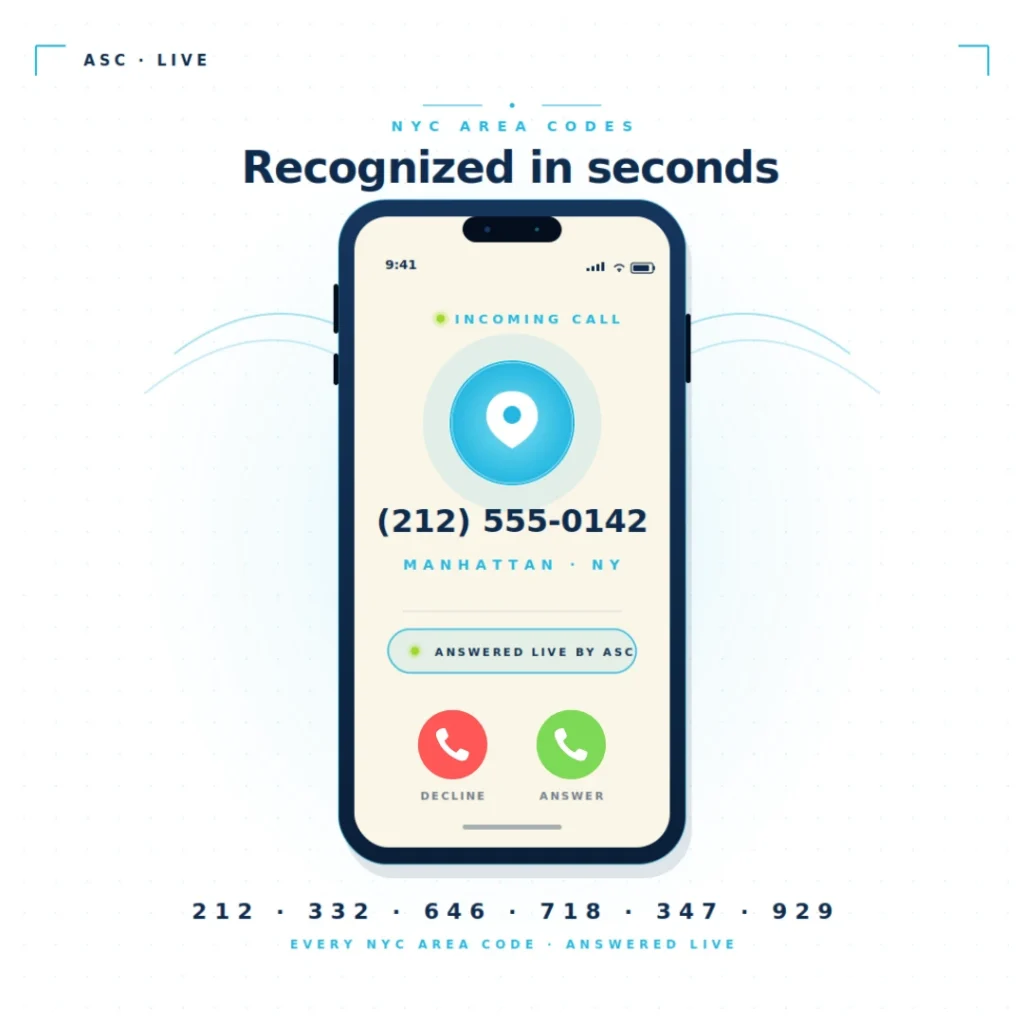
Area codes carry meaning in New York City. A 212, 332, or 646 number signals Manhattan presence. A 718, 347, or 929 number signals Brooklyn, Queens, or the Bronx. Callers often associate these codes with proximity and credibility, particularly in industries where trust matters.
NYC businesses commonly serve customers across ZIP codes such as 10001, 10016, 10022, 10036, 11201, 11215, 11101, 11375, 10451, and 10301. These ZIP codes span commercial corridors, residential neighborhoods, and mixed-use districts where live phone communication remains central to scheduling, intake, and support.
A New York City virtual receptionist reinforces local identity by answering calls live, documenting details clearly, and routing messages in line with your escalation preferences. Instead of directing callers to voicemail, your business maintains a consistent point of contact that aligns with local expectations.
Office Space Rental Cost in New York City and Its Impact on Staffing
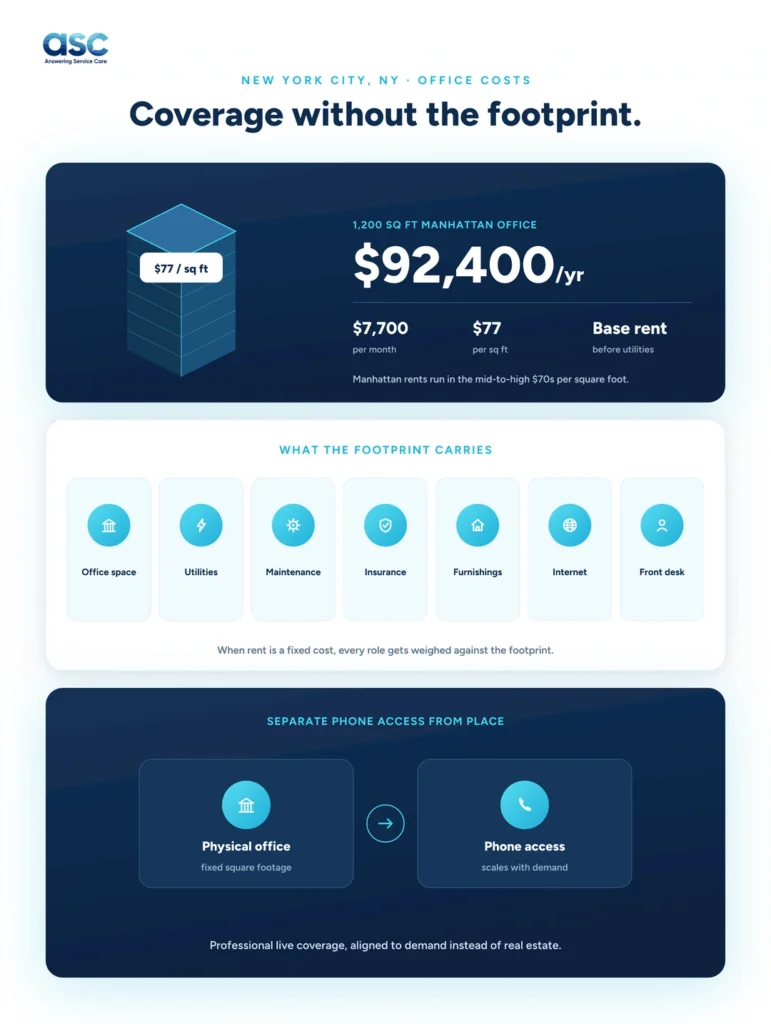
Real estate decisions shape operational structure throughout the five boroughs. Manhattan office rents remain among the highest in the country, frequently averaging in the mid- to high $70s per square foot, depending on building class and neighborhood. In Midtown and the Financial District, premium space commands even higher rates.
To put that into perspective, a 1,200-square-foot office leased at $77 per square foot equates to roughly $92,400 annually in base rent. That is approximately $7,700 per month before utilities, maintenance, insurance, furnishings, and internet are factored in. Larger suites scale proportionally. Even in outer boroughs where rates may be lower, the monthly commitment remains substantial.
When office space rental cost becomes one of the largest fixed expenses on the balance sheet, businesses begin evaluating how each role connects to that footprint. Maintaining a staffed front desk often requires both physical space and layered scheduling. For companies whose client interactions occur primarily by phone, tying reception coverage directly to square footage can limit flexibility.
A New York City answering service allows organizations to maintain professional live coverage while reducing dependence on fixed real estate overhead. This approach separates phone access from physical location, aligning communication costs more closely with actual demand.
Hiring a Receptionist in NYC: Costs, Scheduling, and Coverage Challenges
Staffing phones internally in New York City involves more than assigning someone to the front desk. Coverage must remain consistent through breaks, paid time off, sick days, and turnover. In offices that operate beyond standard business hours, redundancy becomes necessary to prevent service gaps. What appears to be a single role on paper often requires layered scheduling in practice.
Employment regulations in New York add another layer to that planning. New York City employers must comply with the state’s higher minimum wage tier, which currently applies at a higher rate than in many other parts of the country. Receptionists are typically non-exempt hourly employees, meaning their compensation must meet or exceed the local minimum. Overtime requirements under New York labor law also apply once weekly hours exceed forty, increasing payroll exposure if one employee regularly covers extended shifts or after-hours calls.
In addition, New York City’s Paid Safe and Sick Leave Law requires employers to provide paid leave based on company size. When front-desk staff use earned leave, businesses must still maintain uninterrupted phone coverage. That often means cross-training other employees or hiring additional administrative support to fill coverage gaps.
Together, wage requirements, overtime exposure, and mandated leave create predictable but significant staffing obligations. For many organizations, the conversation shifts from replacing a receptionist to evaluating how to maintain reliable call handling without adding additional fixed payroll layers. A structured answering service centralizes intake, documents calls consistently, and routes urgent matters in accordance with defined protocols, helping businesses stabilize coverage while remaining compliant with local employment standards.
Receptionist Salary in NYC and Annual Cost Comparison
According to the U.S. Bureau of Labor Statistics, the annual mean wage for Receptionists and Information Clerks in the New York-Newark-Jersey City metropolitan area is approximately $42,150. That figure reflects base pay only. It does not account for payroll taxes, benefits, paid leave, training, or the additional staffing often required to ensure continuous coverage.
When evaluating total cost, salary is only part of the equation. Office space rental, equipment, supervision, and layered scheduling all contribute to the cost of maintaining in-house phone coverage. Even a modest expansion of coverage hours can significantly increase annual payroll.
For New York City businesses balancing real estate overhead and labor expenses, this comparison illustrates how communication structure influences long-term operating budgets.

Virtual receptionists at ASC cost as little as $40/month, saving you up to $41,670/year in in-house salary costs.
Industries in NYC That Generate the Most Time-Sensitive Phone Traffic
New York City’s economy exceeds $1.3 trillion in output, making it one of the largest metropolitan economies in the world. Its scale is anchored by Finance and Insurance, Professional and Business Services, and a rapidly expanding Technology and Digital Media sector. Global banks, investment firms, consulting groups, law offices, and enterprise technology companies generate a significant share of that output while operating within tightly coordinated, deadline-driven environments across the five boroughs.
These industries rely on live communication for transaction confirmations, regulatory coordination, executive scheduling, compliance documentation, enterprise onboarding, and client support. Many interactions are tied to market hours, court calendars, contract milestones, or deployment timelines, leaving little room for delay. This creates sustained demand for responsive call handling during business hours and well into evenings and weekends. An NYC answering service supports this pace by answering, documenting, and routing calls while internal teams focus on financial strategy, legal matters, advisory work, and product development.

Finance and Insurance form the foundation of New York City’s global economic influence. Lower Manhattan’s Financial District, Midtown’s corporate towers, and offices throughout the city house major institutions such as JPMorgan Chase, Goldman Sachs, Morgan Stanley, Citigroup, and American International Group. In addition to multinational banks and insurance carriers, NYC supports hedge funds, private equity firms, asset managers, broker-dealers, underwriting groups, fintech platforms, and regulatory advisory firms that operate across domestic and international markets.
Inbound call activity in this sector is rarely routine. Calls frequently relate to account onboarding, transaction confirmations, wire transfer verification, compliance documentation, underwriting coordination, regulatory reporting, investor relations, and portfolio management updates. Many interactions are tied directly to market hours, SEC filing deadlines, settlement windows, and contractual obligations. A delayed message can affect funding timelines, reporting accuracy, or client trust.
Financial institutions also manage cross-time-zone communication with clients in Europe, Asia, and the West Coast, which extends call demand beyond traditional 9-to-5 schedules. Operations teams coordinate with legal departments, compliance officers, external auditors, and third-party vendors throughout the day. Live call coverage ensures that time-sensitive information is documented accurately and escalated immediately to the appropriate desk, relationship manager, or on-call executive. In a sector where precision and timing directly influence capital flows, dependable New York City virtual receptionist services serve as operational support rather than administrative convenience.
Accounting and consulting represent another major source of economic activity and inbound call demand in New York City. Global accounting firms, management consultancies, advisory groups, executive search firms, and corporate strategy practices cluster throughout Midtown, Hudson Yards, and Downtown Manhattan. \Deloitte, PwC, EY, and KPMG, maintain major operations in the city, alongside consulting leaders such as McKinsey & Company, Boston Consulting Group, and Bain & Company. New York also supports a dense network of transaction advisory firms, restructuring specialists, compliance consultants, and industry-focused boutique practices.
These firms operate in deadline-driven environments shaped by audits, tax filings, due diligence reviews, board reporting cycles, merger and acquisition activity, regulatory inquiries, and client strategy engagements. Inbound calls frequently involve document coordination, meeting scheduling, partner availability, client onboarding, compliance questions, and multi-party communication across internal teams and external stakeholders.
Call volume often increases during active deal cycles, quarter-end reporting periods, audit windows, and major client engagements, when timing and accuracy become more important. Delayed communication can slow approvals, disrupt deliverables, or create unnecessary friction between teams and clients. Many of these firms also support international clients or cross-border transactions, which extends communication needs beyond standard business hours.
Structured live answering helps ensure that messages are documented clearly, routed to the correct partner, department, or engagement team, and delivered without delay. For accounting and consulting firms in New York City, dependable phone coverage supports client confidence while allowing professionals to stay focused on analysis, advisory work, and time-sensitive deliverables.
New York City’s technology and digital media sector spans enterprise software, fintech, advertising technology, streaming platforms, television networks, and film production companies. Growth is concentrated in Manhattan’s Flatiron District, Hudson Yards, and Midtown South, as well as Brooklyn neighborhoods such as DUMBO and Williamsburg. The city supports firms that operate nationally and globally in fast-moving, highly competitive markets where reliability, brand perception, and sustained client coordination are essential.
Examples include Bloomberg, MongoDB, Datadog, and Etsy, as well as major media and entertainment companies such as NBCUniversal, Paramount Global, and Warner Bros. Discovery. In addition to large corporate headquarters, NYC hosts production studios, post-production facilities, talent agencies, and independent film and television companies that manage broadcast schedules, streaming releases, and commercial media projects across domestic and international markets.
A significant share of this activity intersects with finance, advertising, and global distribution networks, increasing coordination complexity. Across these organizations, inbound calls frequently involve technical support, enterprise onboarding, production scheduling, location permitting, union coordination, vendor logistics, recruiting, and multi-region client communication.
Because technology platforms and media productions operate on structured release timelines and contractual deadlines, missed calls can delay deployments, disrupt filming schedules, or interrupt service continuity, making dependable live call coverage an operational requirement rather than a convenience.
In New York City, responsiveness directly influences reputation. Financial trades settle within market windows. Legal filings adhere to court schedules. Consulting engagements move according to contract milestones. Software deployments follow release calendars. Missed calls create downstream friction that can slow transactions or weaken client confidence.
Live answering supports structured communication. Calls are documented clearly and routed based on established escalation paths. Instead of relying on voicemail retrieval or internal guesswork, businesses maintain a consistent intake system that keeps operations aligned.
For organizations requiring 24-hour answering service NYC coverage due to global markets or extended client hours, structured live answering ensures continuity without expanding internal schedules.
Why NYC Businesses Choose Professional Answering Services
In dense commercial corridors, availability shapes perception quickly. A live professional answer signals organization and reliability. Voicemail often signals delay, even if brief.
Our NYC answering service supports law firms, medical offices, property managers, financial advisors, contractors, and technology companies that cannot afford to miss inquiries. Calls are captured accurately and delivered according to your instructions, allowing your team to focus on billable or strategic work.
Answering Service Coverage Across Manhattan, Brooklyn, Queens, the Bronx, and Staten Island
We provide live answering coverage throughout all five boroughs. Midtown finance offices, Downtown legal firms, Brooklyn real estate groups, Queens healthcare providers, Bronx contractors, and Staten Island service companies each operate under different call patterns and peak periods.
Business districts often experience concentrated weekday volume. Residential-heavy areas generate more evening and weekend inquiries. Our service adapts to these patterns, supporting single-location businesses and multi-borough operations with consistent standards.
How to Forward Your Business Phone to an Answering Service in NYC
Businesses in New York City commonly rely on carriers such as Verizon, AT&T, T-Mobile, Spectrum, and Comcast Business for both mobile and office phone lines. All of these providers offer call-forwarding features that let companies route incoming calls to a live answering service without changing their primary business number.
Call forwarding can be configured for full-time coverage, after-hours support, or overflow periods during peak demand. This flexibility allows businesses to maintain control over how and when calls are routed while preserving a seamless caller experience. Our call-forwarding guides simplify the setup process and help ensure coverage transitions smoothly, whether the goal is reducing interruptions during the workday or maintaining 24-hour availability with Answering Service Care.